
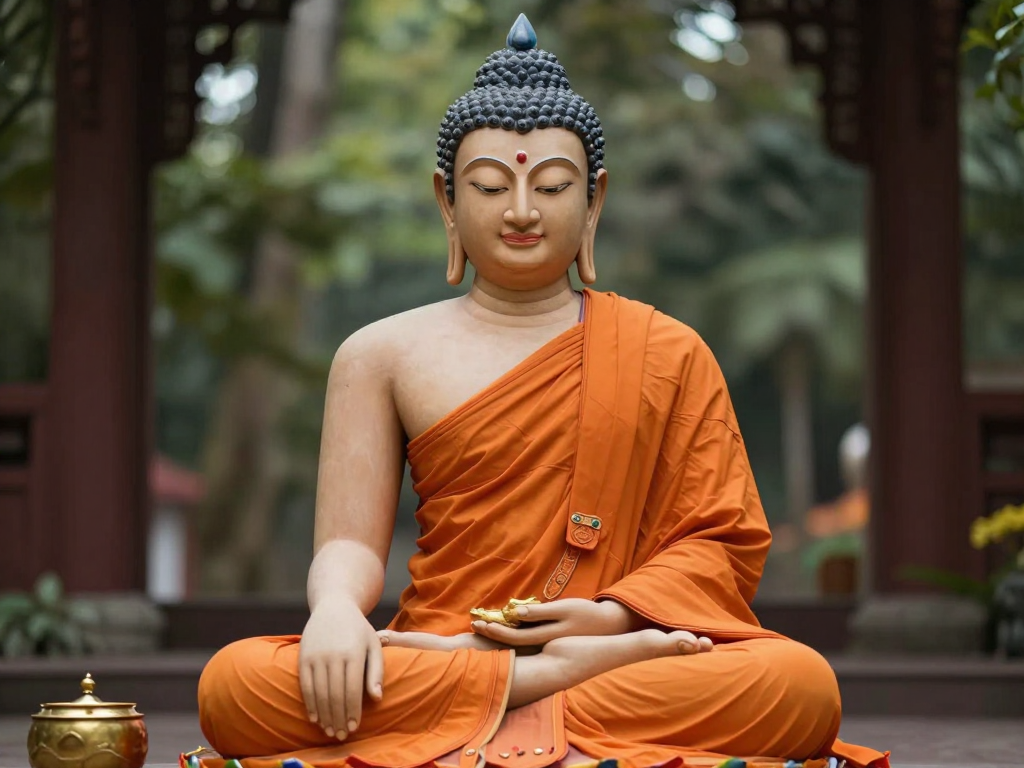
More than 2,500 years ago, in the foothills of the Himalayas, a prince abandoned a throne to search for the root of human suffering. What he discovered beneath a sacred fig tree became one of the most transformative philosophies the world has ever known — a living tradition now followed by nearly half a billion people across every continent on Earth.
Buddhism
Siddhartha Gautama (the Buddha)
South Asia · c. 5th–4th century BCE
Key Dates at a Glance
- c. 563 BCEBirth of Siddhārtha Gautama in Lumbini (modern Nepal)
- c. 534 BCEThe Great Renunciation — leaves palace life at age 29
- c. 528 BCEEnlightenment attained under the Bodhi Tree in Bodh Gayā
- c. 528 BCEFirst Sermon at Deer Park, Sārnāth — the Dhamma Chakka is set in motion
- c. 483 BCEMahāparinirvāṇa — final passing at Kuśinara at age 80
Historical & cultural background
A World on the Brink of Transformation
The sixth and fifth centuries BCE witnessed a remarkable explosion of intellectual and spiritual inquiry across Eurasia — what philosopher Karl Jaspers famously termed the Axial Age. Confucius was teaching in China, Zoroaster's influence spread through Persia, the Hebrew prophets were reshaping monotheism, and the pre-Socratics were laying foundations of Western philosophy. Into this ferment of ideas, the Buddha emerged.
The Indian subcontinent of his era was itself a mosaic of competing philosophies. The orthodox Brahmanical tradition, anchored in Vedic ritual and caste hierarchy, coexisted with Śramaṇa movements — wandering ascetics who rejected Vedic authority in favor of personal liberation through austere practice. The Jains, under Mahāvīra (a near-contemporary of the Buddha), offered one such path; the Buddha would chart another.
The Ganges plain where Buddhism took root was also a zone of rapid urbanisation. New kingdoms and republics were displacing older tribal structures; trade routes were generating merchant wealth; the old certainties of caste and ritual were being questioned. The Buddha's message — that liberation was available to all, regardless of birth — resonated deeply in precisely this climate of social flux.
From Prince to the Awakened One
Siddhārtha Gautama was born into the Shakya clan, a noble warrior family (Kṣatriya) in the kingdom of Kosala, at the site now known as Lumbini in present-day Nepal. Early texts portray his birth as accompanied by portents: a sage prophesied that the infant would become either a universal monarch or a fully enlightened Buddha. His father, King Suddhodana, chose to shelter him from suffering in the hope he would choose the former path.
The palace years gave Siddhārtha every material pleasure — education, marriage to Yaśodharā, and eventually a son, Rāhula. Yet the so-called Four Sights — an old man, a sick man, a corpse, and finally a serene wandering ascetic — shattered the carefully constructed illusion of permanence. At twenty-nine, he slipped out of the palace by night, shaved his head, donned the ochre robe of a renunciant, and set out to discover the truth of human existence.
Six years of intense practice followed: studies under two eminent meditation masters, then a period of such severe asceticism that he nearly died. Recognising that neither extreme — sensual indulgence nor harsh self-mortification — led to liberation, he formulated the Middle Way. Seated beneath a Ficus religiosa (the Bodhi tree) at Bodh Gayā in modern Bihar, he entered a night of profound meditation, overcame the temptations of Māra, and at dawn attained complete, unobstructed insight — bodhi, awakening.
The Dhamma: What the Buddha Taught
The content of the Buddha's first sermon at Deer Park, Sārnāth — the Dhammacakkappavattana Sutta, or "Setting in Motion the Wheel of the Dhamma" — established the architecture of all subsequent Buddhist thought. It presented the Four Noble Truths: that suffering (dukkha) is an inescapable feature of conditioned existence; that suffering arises from craving and clinging; that the cessation of craving leads to the cessation of suffering; and that the Noble Eightfold Path — encompassing right view, right intention, right speech, right action, right livelihood, right effort, right mindfulness, and right concentration — constitutes the practical road to that cessation.
These teachings were radical in their emphasis on personal investigation over ritual authority. The Buddha famously urged his followers not to accept teachings on the basis of tradition or scripture alone, but to test them against their own lived experience — an empiricist streak that would prove enduring across Buddhist cultures.
Two further doctrines distinguished Buddhism profoundly from its contemporaries: the teaching of anāttā (non-self), which denied the existence of a permanent, unchanging soul, and pratītyasamutpāda (dependent origination), which articulated how all phenomena arise in interdependence rather than from a first cause or creator deity.
A Legacy Woven into Civilisations
Few single individuals have shaped more cultures across more centuries. From the rock edicts of Emperor Aśoka (3rd century BCE) — which carried Buddhist ethics across the Mauryan Empire and beyond — to the exquisite cave paintings of Ajanta, the colossal statues of Bamiyan, the Zen gardens of Kyoto, the meditation halls of Myanmar, and the Tibetan thangka tradition, Buddhism generated one of history's richest artistic and intellectual heritages.
The Silk Road served as Buddhism's highway. Monks, merchants, and manuscripts carried the Dhamma into Central Asia, China, Korea, Japan, and Southeast Asia over roughly a millennium of transmission. Each culture Buddhism encountered was transformed — and, in turn, transformed Buddhism, producing the remarkable variety of Theravāda, Mahāyāna, and Vajrayāna lineages still flourishing today.
The Ancient Voice in a Contemporary World
Buddhism arrived in the Western world through nineteenth-century Orientalist scholarship, the Theosophical movement, and eventually the migration and diaspora of Asian teachers in the twentieth century. By the 1960s it had become intertwined with the counterculture; by the 1990s, mindfulness — a direct descendant of the Buddha's instructions on sati — had entered mainstream medicine, with Jon Kabat-Zinn's MBSR programme introducing contemplative practice into hospitals and clinics worldwide.
Today, neuroscientists collaborate with Buddhist monks in studies of meditation; the Buddha's analyses of mind and emotion anticipate aspects of cognitive behavioural therapy; and his ecological philosophy — rooted in interdependence and compassion for all sentient beings — speaks with fresh urgency to an era of climate crisis. Across every continent, the quiet revolution begun in a deer park outside Varanasi continues to unfold.
With an estimated 350–550 million practitioners, Buddhism stands as the world's fourth-largest religion. Yet its founder consistently resisted the title of god, prophet, or saviour — describing himself simply as one who had woken up, and insisting that every human being carried the same capacity for awakening within themselves.
Core teachings
- 1.All beings deserve compassion.
- 2.Suffering arises from craving and clinging; freedom comes through awareness.
- 3.Practice loving-kindness toward yourself and others.
- 4.Walk a middle path — neither indulgence nor harsh self-denial.
Suggested further reading
- The Dhammapada
- Thich Nhat Hanh, Old Path White Clouds
These summaries are educational and simplified — they cannot capture the depth of any tradition.