
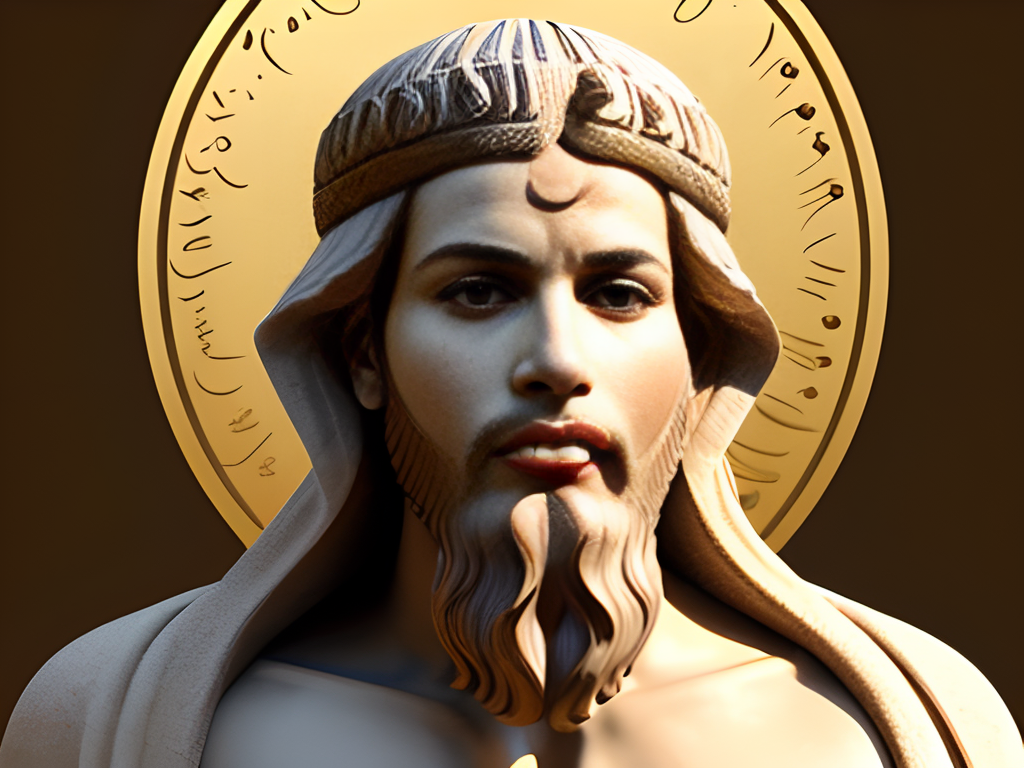
Born an orphan in the merchant city of Mecca in the sixth century CE, Muhammad ibn Abdullah received, over twenty-three years, a series of revelations he understood as the direct word of God. The scripture those revelations produced — the Quran — became the foundation of Islam, a faith that within a century of his death had unified the Arabian Peninsula, toppled two empires, and set in motion one of history's most extraordinary cultural and intellectual flowerings.
Islam
Muhammad
Middle East · c. 570 – 632 CE
Key Dates at a Glance
- 570 CEBirth in Mecca in the Year of the Elephant; father Abdullah already deceased
- 610 CEFirst revelation on Mount Hira during the month of Ramadan; the angel Jibril appears
- 622 CEThe Hijra — emigration from Mecca to Medina; Year 1 of the Islamic calendar
- 630 CEConquest of Mecca; the Ka'ba cleansed and rededicated to God
- 632 CEFarewell Pilgrimage and death in Medina; the entire Arabian Peninsula unified under Islam
Historical & cultural background
Arabia on the Eve of Islam
The Arabia of Muhammad's birth was a world poised between two exhausted superpowers. To the north and west, the Byzantine Empire — Christian, Greek-speaking, and ancient — controlled Syria, Egypt, and Anatolia but had been bled nearly dry by decades of war with its eastern rival. To the northeast, the Sasanian Persian Empire, Zoroastrian in faith and heir to millennia of Persian civilisation, had likewise suffered catastrophic losses in the same Byzantine–Persian wars that raged from 602 to 628 CE. Both empires were weakened, their frontier provinces restless, their tax bases strained to breaking point.
The Arabian Peninsula itself lay largely beyond the reach of either empire. Its interior was dominated by nomadic Bedouin tribal confederations — fierce, intensely honour-bound, and organised around a complex web of alliances and blood feuds. The trading cities of the Hijaz, however, occupied a different world. Mecca, home of the ancient sanctuary known as the Ka'ba, was a thriving commercial hub where caravans connecting Yemen, Syria, and Iraq converged. The tribe that controlled it, the Quraysh, had grown wealthy on trade and the income from pilgrims visiting the Ka'ba — then housing some 360 tribal idols — from across the peninsula.
Religiously, Arabia was pluralist. Polytheistic tribal religion coexisted with significant Jewish communities (especially in Medina and Yemen), Christian communities, and a scattered group known as the Hanifs — Arabic monotheists who rejected both idolatry and the established Abrahamic traditions while seeking a purer form of faith. Muhammad himself is described in early sources as having been deeply influenced by this Hanif current before his revelation. It was into this charged, plural, commercially sophisticated world that Islam emerged — not from a cultural vacuum, but from a landscape saturated with religious searching.
From Orphan to Prophet to Statesman
Muhammad was born around 570 CE into the Hashim clan of the Quraysh tribe. His father Abdullah died before his birth; his mother Amina died when he was six. Raised first by his grandfather Abd al-Muttalib and then by his uncle Abu Talib, he grew up on the margins of Meccan society — connected to the city's powerful elite by blood but without wealth or paternal protection. He worked as a shepherd and later joined the caravan trade, earning a reputation for honesty and reliability that won him the epithet al-Amin — 'the Trustworthy.'
At twenty-five, he entered the employ of Khadijah, a wealthy widow and successful merchant fifteen years his senior. Impressed by his character, she proposed marriage; they wed and remained monogamous until her death twenty-five years later. Khadijah was the first to believe his account of the revelation — a fact Muslims regard as foundational. The revelations continued for twenty-three years, eventually comprising the 114 surahs (chapters) of the Quran, memorised and recited by his companions and compiled into a single written text under the Caliph Uthman (c. 650 CE).
The turning point of his career was the Hijra of 622 CE — the emigration from Mecca (where his message had provoked the Quraysh elite into persecution) to the oasis city of Yathrib, henceforth known as Madinat al-Nabi — the City of the Prophet, or simply Medina. Here Muhammad transformed from preacher into statesman, drafting the Constitution of Medina — an agreement establishing a political community (ummah) encompassing Muslim, Jewish, and pagan Arab tribes under a shared framework of rights and obligations. It is one of the world's earliest written constitutional documents.
The Message of Islam
The Arabic word Islam means 'submission' or 'surrender' — specifically, the surrender of the self to the one God, Allah. Muhammad presented his message not as a new religion but as the restoration and completion of the same monotheistic tradition revealed to Abraham, Moses, and Jesus. He is considered by Muslims the final prophet in that line — the Seal of the Prophets — sent to correct accumulated distortions and deliver a definitive, preserved revelation to all humanity.
The Five Pillars of Islam provide the practical architecture of Muslim life: the Shahada (declaration of faith — 'There is no god but God, and Muhammad is His messenger'); Salat (five daily prayers oriented toward Mecca); Zakat (obligatory almsgiving — typically 2.5% of savings, expressing Islam's structural commitment to wealth redistribution); Sawm (fasting during the month of Ramadan); and Hajj (pilgrimage to Mecca at least once in a lifetime, for those able). These five acts integrate worship, social solidarity, bodily discipline, and communal identity into the fabric of daily and annual life.
Muhammad's ethical teaching was inseparable from social reform. He arrived in a society where female infanticide was practised, slavery was unrestricted, and tribal membership determined every right. The Quran explicitly curtailed female infanticide, established inheritance rights for women (unprecedented in the region), limited slavery and mandated humane treatment, and repeatedly emphasised that no Arab was superior to a non-Arab — and no non-Arab to an Arab — except in piety. His Farewell Sermon, delivered on Mount Arafat in 632 CE to over 100,000 pilgrims, is regarded by many historians as one of antiquity's most remarkable declarations of human equality.
The Civilisation Islam Built
The speed of Islam's expansion after Muhammad's death in 632 CE remains one of history's most astonishing phenomena. Within a century, Muslim armies and missionaries had swept across Persia, the Levant, Egypt, North Africa, Spain, and Central Asia — creating an empire larger than Rome at its height. This was not merely military conquest. The new Islamic world absorbed, translated, preserved, and extended the intellectual heritage of Greece, Persia, India, and Byzantium at a moment when much of that heritage was at risk of being lost.
The Islamic Golden Age (roughly 8th–13th centuries CE) produced an outpouring of scholarship without parallel in the medieval world. In Baghdad's Bayt al-Hikmah (House of Wisdom), scholars translated Aristotle, Plato, Galen, and Euclid into Arabic, then built decisively upon them. Ibn Sina (Avicenna) codified medicine in his Canon of Medicine, the standard European medical text until the 17th century. Al-Khwarizmi gave mathematics algebra (the word itself is Arabic: al-jabr). Al-Haytham (Alhazen) established the foundations of optics and the scientific method. Al-Biruni measured the Earth's circumference with remarkable accuracy. Ibn Battuta traversed 75,000 miles across three continents. And in the great libraries of Córdoba, Cairo, and Samarkand, millions of volumes accumulated while European monasteries preserved a fraction of what had survived.
Arabic became, for five centuries, the primary language of science, philosophy, and medicine across the known world — the Latin of its age. Islamic architecture produced the Alhambra, the Dome of the Rock, the Blue Mosque, and the great madrasas of Fez and Timbuktu. Islamic calligraphy elevated writing to one of the world's supreme art forms. And the institution of the waqf — charitable endowment — funded hospitals, libraries, and schools across the Islamic world centuries before such institutions became common elsewhere.
1.8 Billion and the Living Tradition
Islam is today the world's second-largest religion, with approximately 1.8 billion adherents — nearly a quarter of humanity — and the fastest-growing major faith by birth rate and conversion. It encompasses breathtaking diversity: the ancient Sunni–Shia division, itself rooted in the succession crisis that followed Muhammad's death; the mystical Sufi orders that spread Islam across sub-Saharan Africa and South and Southeast Asia through music, poetry, and personal devotion; the reform movements of the 18th and 19th centuries responding to colonialism; and the vast variety of national cultures — from Indonesian batik to Malian mud-brick mosques — that now constitute the living fabric of the Muslim world.
The Quran remains, uniquely among world scriptures, a text that hundreds of millions of its adherents have memorised in full — the huffaz, or memorisers, constituting a living chain of oral preservation stretching back to the Prophet's companions. The adhan (call to prayer) is heard five times daily in cities from Lagos to Jakarta to London. During Ramadan, the largest collective act of fasting in human history takes place across every time zone on Earth simultaneously.
The life of Muhammad — its mixture of spiritual depth, political realism, personal vulnerability (he outlived multiple children, lost his first beloved wife, faced years of persecution), and ultimate triumph — continues to serve as the normative model for Muslim life. To Muslims, he is al-Insan al-Kamil: the Complete Human Being. To historians, he remains among the most consequential individuals who ever lived — a man who, in twenty-three years, changed the trajectory of a civilisation.
Core teachings
- 1.Show mercy and you will be shown mercy.
- 2.Give in charity, especially to those in greatest need.
- 3.Stand for justice, even against your own interests.
- 4.All people share one human origin.
Suggested further reading
- Martin Lings, Muhammad: His Life Based on the Earliest Sources
These summaries are educational and simplified — they cannot capture the depth of any tradition.