
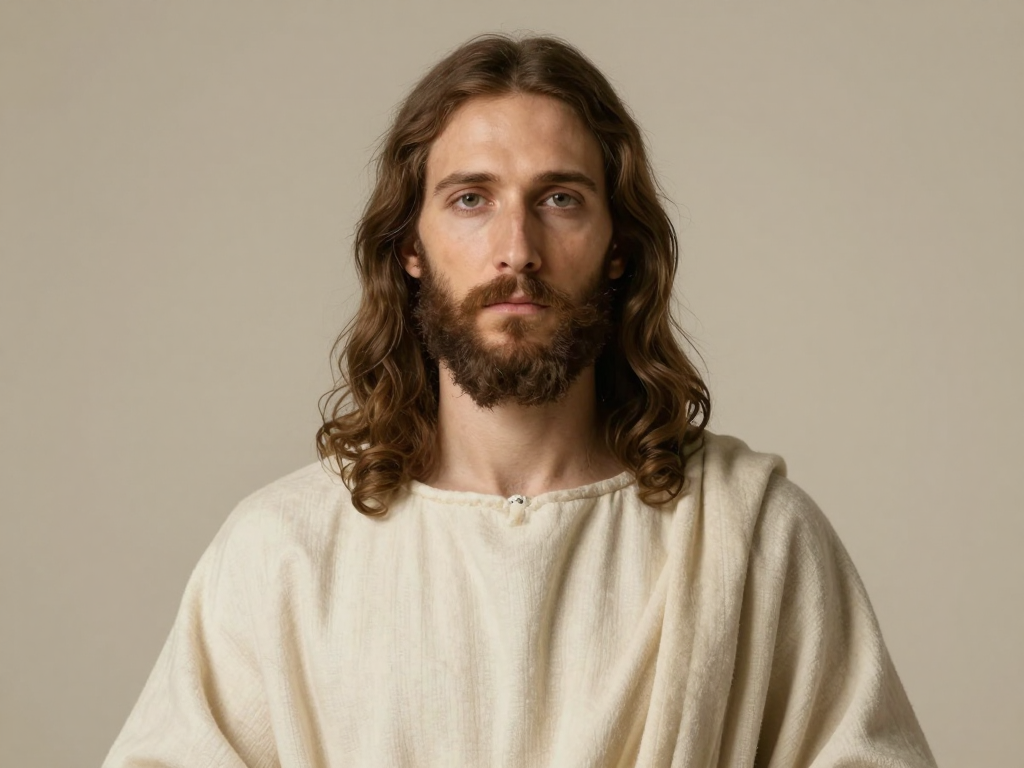
Born in a corner of the Roman Empire during the reign of Augustus Caesar, a Jewish preacher from Galilee spent perhaps three years teaching, healing, and provoking authorities before his execution at the hands of Roman power. Within three centuries his followers had transformed that empire from within — and within two millennia, Christianity had become the world's largest religion, shaping law, art, science, ethics, and politics on every continent.
Christianity
Jesus of Nazareth
Middle East · c. 4 BCE – 30 CE
Key Dates at a Glance
- c. 4 BCEBirth in Bethlehem (or Nazareth) during the reign of Herod the Great
- c. 27–29 CEBaptism by John the Baptist in the Jordan River; beginning of public ministry
- c. 30–33 CEEntry into Jerusalem; Last Supper; arrest in Gethsemane
- c. 30–33 CECrucifixion under Pontius Pilate; Resurrection accounts; Pentecost
- c. 48–100 CEPaul's epistles and the four Gospels composed; rapid spread across the Mediterranean
Historical & cultural background
The World Jesus Was Born Into
In the first century BCE, Judea had fallen under Roman domination following the conquests of Pompey (63 BCE). By the time of Jesus's birth, the region was a client kingdom under Herod the Great — a ruler celebrated for massive building projects, including the spectacular expansion of the Second Temple in Jerusalem, but deeply resented for his brutality and perceived collaboration with Rome. The tension between Roman imperial power and Jewish religious identity defined every corner of daily life.
Judaism itself was far from monolithic. The Pharisees emphasised oral law and personal piety; the Sadducees, largely a priestly aristocracy, controlled the Temple and cooperated with Rome; the Essenes had withdrawn into desert communities to await divine intervention; the Zealots advocated armed revolt. Into this crowded landscape of competing Jewish visions, Jesus arrived — shaped by all of it and ultimately transcending all of it.
The broader Greco-Roman world provided the highways along which the new faith would travel. Roman roads, a common language (Koinē Greek), and a single legal framework stretching from Britain to Mesopotamia created, almost inadvertently, the ideal infrastructure for a missionary religion. The Pax Romana had unified the Mediterranean world even as it oppressed Judea — and it was along its trade routes that Paul of Tarsus and countless other missionaries would carry the Gospel within a generation of Jesus's death.
The Man from Galilee
Jesus was born, most scholars agree, sometime between 6 and 4 BCE — the apparent paradox arising from a sixth-century miscalculation by the monk Dionysius Exiguus when he designed the modern calendar. The Gospels of Matthew and Luke place his birth in Bethlehem, fulfilling the Messianic prophecy of Micah 5:2, though he was raised in Nazareth in Galilee — a fact so well established that he was consistently referred to as "the Nazarene." His mother Mary and (legal) father Joseph were observant Jews; he was circumcised, presented at the Temple, and educated in Torah.
Around 27–29 CE, Jesus presented himself to John the Baptist at the River Jordan — a charismatic preacher who proclaimed an imminent divine reckoning and baptised penitents as a sign of spiritual renewal. This baptism marks the beginning of Jesus's documented public career. He assembled a core group of twelve disciples drawn from the fishing communities and tax offices of Galilee, and began proclaiming the Kingdom of God — a phrase that carried simultaneously spiritual, social, and political resonances his contemporaries would immediately have recognised.
Jesus is among the best-attested figures of the ancient world outside purely classical literature. Beyond the Gospels and Paul's epistles, he is mentioned by the Roman historian Tacitus (Annals XV.44, c. 116 CE) and the Jewish historian Josephus (Antiquities XX.9.1, c. 93 CE). Historians of antiquity broadly concur on a core biographical skeleton: Jewish preacher from Galilee, baptised by John, gathered followers, taught and performed acts described as miraculous, was crucified under Pontius Pilate — a terminus no serious historian disputes.
What Jesus Taught
Jesus taught almost entirely through parable, aphorism, and dramatic symbolic action rather than systematic theological treatise. His central proclamation — the Kingdom of God (or Kingdom of Heaven in Matthew's Gospel) — was simultaneously present reality and imminent fulfilment, spiritual interior state and radical social vision. He invited his listeners to inhabit it now, through transformed relationships with God, neighbour, and enemy alike.
The Sermon on the Mount (Matthew 5–7), widely regarded as the ethical centrepiece of his teaching, reinterprets the Torah through a lens of radical inwardness and mercy. The Beatitudes open with counterintuitive blessings — for the poor in spirit, the meek, the peacemakers, those who mourn. The sermon intensifies the demands of the Law: it is not enough to avoid murder; anger itself is the problem. Not enough to avoid adultery; lust is already the transgression. Yet the same sermon insists that God's grace falls "on the just and the unjust alike" — a combination of exacting moral seriousness and extravagant mercy that defied every contemporary expectation.
Two commandments Jesus identified as the foundation of all the rest: love God with one's whole being, and love one's neighbour as oneself. When pressed on who qualified as a "neighbour," he responded with the Parable of the Good Samaritan — making a despised ethnic outsider the moral hero of the story, and radically dismantling the limits of obligation. His consistent attention to those marginalised by society — the poor, the sick, women, tax collectors, Samaritans, Gentiles — was not incidental but structural to his message.
How Christianity Remade the World
The execution of Jesus by crucifixion — the Roman Empire's most degrading punishment for slaves and criminals — should, by every historical logic, have ended the movement. Instead, the disciples' accounts of a resurrection transformed a moment of catastrophic defeat into the foundational event of a new faith. Within twenty years, communities of Jesus-followers existed across the eastern Mediterranean. Within three centuries, Christianity had become the official religion of the Roman Empire under Constantine I (Edict of Milan, 313 CE).
The cultural consequences are almost impossible to overstate. Christian monasteries preserved classical learning through the collapse of the Western Roman Empire, laying foundations for medieval scholarship. The concept of universal human dignity — rooted in the imago Dei (every person made in God's image) — eventually underpinned the development of human rights philosophy. The Christian calendar structured European time; Christian architecture produced the Romanesque, Gothic, and Baroque traditions; Christian patronage funded the Sistine Chapel, Chartres Cathedral, Bach's cantatas, and Dante's Divine Comedy.
The hospital as an institution originated in Christian practice — the first dedicated care facilities for the sick established by bishops in the fourth century. Universities across medieval Europe grew from cathedral schools. The abolition of slavery in the nineteenth century was substantially driven by evangelical Christians such as William Wilberforce; the American civil rights movement found both leadership and language in Black churches. The reach is total and ongoing.
Two Billion Voices, One Name
Christianity today claims approximately 2.4 billion adherents — roughly a third of humanity — making it the world's largest religion by any measure. It encompasses a staggering diversity: from the ancient liturgical traditions of Eastern Orthodoxy and the Catholic Church, which traces its institutional lineage to the first century, to the explosive growth of Pentecostalism across Africa, Latin America, and Asia; from high Anglican cathedrals in England to mud-brick churches in South Sudan; from liberation theology to prosperity gospel.
Secular Western thought remains saturated with Christian assumptions even where it has explicitly rejected them. The idea that history moves toward a goal (rather than cycling endlessly) is a secularised eschatology. Modern concepts of conscience, sin, redemption, and the dignity of the individual person all carry Christian genealogies that philosophers from Nietzsche to Habermas have been compelled to reckon with. To understand the contemporary world — its politics, its art, its moral vocabulary — requires understanding Jesus of Nazareth.
His words, originally spoken in Aramaic to a few hundred listeners in a remote province of the Roman Empire, have now been translated into over 3,500 languages — more than any other text in human history. The question he posed to his disciples at Caesarea Philippi — "But who do you say that I am?" — has never ceased to generate answers, arguments, art, and transformation.
Core teachings
- 1.Love your neighbor as yourself, and even love those who oppose you.
- 2.Care for the poor, the sick, the stranger, and the forgotten.
- 3.Practice forgiveness without keeping count.
- 4.Approach others with humility rather than self-promotion.
Suggested further reading
- The Sermon on the Mount (Matthew 5–7)
- Karen Armstrong, A History of God
These summaries are educational and simplified — they cannot capture the depth of any tradition.