
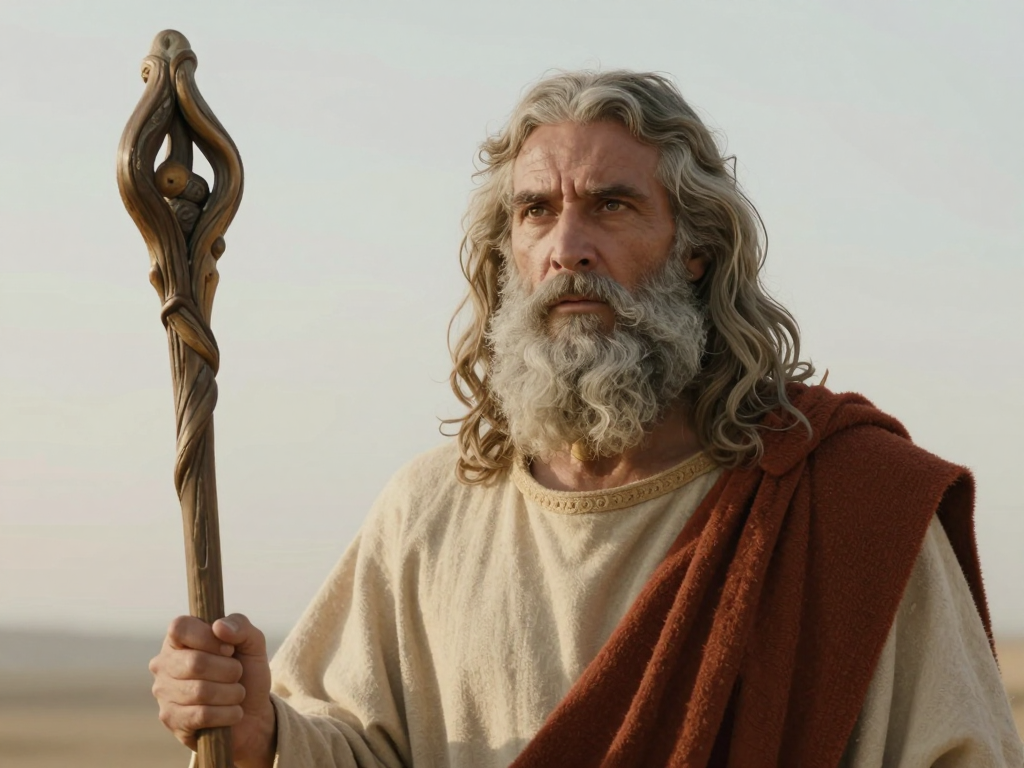
Drawn from the waters of the Nile as an infant, raised in the court of Pharaoh, and driven by divine command into the desert, Moses stands at the origin point of three of the world's great religions. The Torah he is said to have received on Mount Sinai — with its Ten Commandments and sweeping legal code — became the bedrock of Jewish law, the foundation from which Christian ethics grew, and a touchstone acknowledged in the Quran. No other figure in history has given more people more of the moral language they live by.
Judaism
Moses
Middle East · Traditionally c. 13th century BCE
Key Dates at a Glance
- c. 13th C. BCEBirth in Egypt during a period of Israelite enslavement; hidden in the Nile by his mother Jochebed
- c. 1280 BCEThe Burning Bush on Mount Horeb; the divine name YHWH revealed; the call to lead Israel out of Egypt
- c. 1250 BCEThe Exodus from Egypt; the crossing of the Red Sea; the destruction of Pharaoh's army
- c. 1250 BCEThe Covenant at Mount Sinai; the Ten Commandments and the giving of the Torah
- c. 1210 BCEDeath on Mount Nebo, overlooking the Promised Land he was not permitted to enter
Historical & cultural background
Egypt, Empire, and a People in Bondage
The world of Moses was dominated by the towering power of New Kingdom Egypt — one of antiquity's most sophisticated and enduring civilisations. During the Nineteenth Dynasty, pharaohs such as Seti I and Ramesses II (the Great) ruled an empire stretching from Nubia to the Euphrates, marshalling enormous workforces of conquered and enslaved peoples to construct the monumental building projects — temples, cities, obelisks — that still astonish the modern world. Among those labour forces, the biblical account places the Israelites: a Semitic people descended, according to Genesis, from Abraham, Isaac, and Jacob, who had settled in the land of Goshen in the Nile Delta generations earlier.
The historical record from Egyptian sources makes no direct mention of Moses or the Exodus — a silence that has generated centuries of scholarly debate. Most mainstream historians today treat Moses as a figure rooted in genuine historical memory, with the Exodus narrative reflecting real experiences of Semitic migration and bondage in Egypt, even if the scale and details were shaped by later theological interpretation. Archaeological evidence confirms extensive Semitic presence in the Nile Delta during the New Kingdom period, and the Merneptah Stele (c. 1208 BCE) — the earliest non-biblical reference to "Israel" — confirms the existence of an Israelite people in Canaan by that date.
The broader Near Eastern world of the second millennium BCE was already rich in legal tradition. The Code of Hammurabi (c. 1754 BCE) in Babylon had established a sophisticated framework of civil law. Hittite treaty forms closely resemble the structure of the Sinai Covenant. Egyptian wisdom literature shares striking parallels with the book of Proverbs. Moses and the Torah he bequeathed did not emerge from a cultural vacuum — but what made the Sinaitic law code distinctive was its insistence that the ultimate lawgiver was not a king or a human legislator, but God himself, and that the law applied equally to king and commoner, Israelite and stranger alike.
A Life Written in Three Acts
The life of Moses as told in the books of Exodus, Leviticus, Numbers, and Deuteronomy — the four books that follow Genesis and together with it comprise the Torah — unfolds in three dramatically distinct movements. The first is the story of his survival and education: born during a royal decree ordering the death of all Israelite male infants, his mother Jochebed placed him in a papyrus basket in the Nile, where he was discovered by Pharaoh's daughter and raised as an Egyptian prince. His very name, Moshe in Hebrew, is associated with the verb mashah — "to draw out" — the act of his rescue from the water that defined his destiny.
The second act begins with a moment of violence and conscience: Moses kills an Egyptian overseer he sees beating a Hebrew slave and flees into the desert of Midian. Here, tending the flocks of his father-in-law Jethro, he encounters the divine at the Burning Bush on Mount Horeb — a bush that blazes but is not consumed. God reveals the sacred name YHWH (often rendered "I AM WHO I AM" or "I WILL BE WHAT I WILL BE") and commissions Moses to return to Egypt to demand the liberation of the Israelites. Moses protests his inadequacy — he is, by his own account, "slow of speech" — and the text presents his reluctance as part of the authentic encounter.
The third act encompasses the Exodus itself: the ten plagues visited upon Egypt, the Passover night and the death of the firstborn, the dramatic crossing of the Red (or Reed) Sea, the forty years of wilderness wandering, and the giving of the Law at Sinai. It ends, with extraordinary poignancy, on a mountaintop. Moses climbs Mount Nebo, looks out across the Jordan River to the Promised Land he has spent forty years moving toward, and dies — forbidden to enter because of a single act of faithlessness at Meribah. Deuteronomy 34 records that "no one knows his burial place to this day."
The Law That Shaped Civilisation
The Torah attributed to Moses is not simply a religious document; it is one of the most consequential legal and ethical texts in the history of human civilisation. At its heart stand the Ten Commandments (Aseret HaDibrot — the Ten Utterances), delivered twice in the Torah — in Exodus 20 and Deuteronomy 5 — and addressed not to a king or a priestly class but to the whole people gathered at the foot of the mountain. Their scope is total: obligations to God (worship, rest, reverence), obligations to parents, and obligations to the community (prohibitions on murder, theft, adultery, false witness, and covetousness). They represent perhaps the earliest surviving attempt to articulate a universal moral minimum.
Around the Decalogue, the Torah built an elaborate legal system — the mitzvot (commandments), traditionally numbered at 613 — governing everything from dietary practice and agricultural tithing to the treatment of workers, slaves, foreigners, and the poor. Leviticus 19:18 — "Love your neighbour as yourself" — is perhaps the Torah's most distilled ethical statement; Jesus would later call it the second greatest commandment. The same chapter instructs: "When a stranger resides with you in your land, you shall not wrong him... you shall love him as yourself, for you were strangers in the land of Egypt." The memory of oppression becomes the ground of moral obligation.
The Sabbath — the seventh day of rest commanded at Sinai — is arguably Moses's most radical social institution. In a world of unceasing agricultural and slave labour, the Sabbath mandated rest not only for Israelites but for servants, animals, and resident foreigners alike. It encoded into the weekly rhythm of life the principle that no human being is merely an instrument of production — a revolutionary idea whose reverberations are still felt in concepts of the weekend, labour rights, and the dignity of rest.
Three Faiths, One Foundation
Moses is the only figure venerated as a central prophet or lawgiver by all three Abrahamic faiths simultaneously — and his influence extends well beyond them. In Judaism, he is simply Moshe Rabbenu — Moses Our Teacher — the greatest of all prophets, the man who received the Torah at Sinai and whose teachings have structured Jewish life, law, and identity for over three millennia. Every page of the Talmud is, in one sense, a commentary on Moses.
In Christianity, Moses appears in over eighty New Testament passages. He stands alongside Elijah at the Transfiguration of Jesus; his Exodus narrative is read typologically as prefiguring baptism, the Eucharist, and the entire arc of salvation. The Ten Commandments were incorporated wholesale into Christian moral teaching and became, through the medieval catechetical tradition, the framework within which hundreds of millions of children were taught what it meant to live rightly. In the Quran, Moses — called Musa — is the most frequently mentioned of all the prophets, appearing in 136 verses across 34 surahs, described as one of the five greatest prophets (Ulul Azm) and the one with whom God spoke directly.
The secular inheritance of Moses is no less profound. The Exodus narrative — slavery, liberation, the long journey toward a promised land — has served as the master narrative of countless liberation movements across history. The Puritan settlers of New England cast themselves as a new Israel crossing a new wilderness. Frederick Douglass invoked Moses in the abolitionist cause. Harriet Tubman, who led over seventy enslaved people to freedom, was called "Moses" by those she guided. Martin Luther King Jr.'s final speech — delivered the night before his assassination — drew explicitly on Moses's view from Mount Nebo: "I've been to the mountaintop... I've seen the Promised Land. I may not get there with you."
The Lawgiver Who Never Grows Old
Moses occupies a singular position in the modern world. His image has been invoked across the political spectrum — by conservatives defending the biblical basis of Western law (his likeness appears in a marble frieze in the United States Supreme Court chamber, and above the main entrance of the Library of Congress) and by progressives citing the Exodus as the paradigmatic story of oppression overcome. No other ancient figure has been so consistently re-appropriated, re-imagined, and re-deployed across so many different historical moments and political causes.
In popular culture, Moses has been portrayed more times than almost any other religious figure — from the ten-commandment films of Cecil B. DeMille to the animated Prince of Egypt (1998), which presented his story to a new generation with remarkable fidelity to the biblical text. Michelangelo's Moses (c. 1513–1515), carved for the tomb of Pope Julius II and now in San Pietro in Vincoli, Rome, remains one of the most powerful sculptures ever made — a figure radiating authority so intense that Sigmund Freud wrote an entire essay, Der Moses des Michelangelo, trying to understand it.
For the world's approximately 15 million Jews, Moses remains the supreme teacher — but the Passover Seder, which re-enacts the Exodus narrative every year in Jewish homes across the globe, is also observed in some form by hundreds of millions of Christians. The question asked at every Seder table — "Why is this night different from all other nights?" — is, in the deepest sense, a question Moses put to history. And history has never stopped answering it.
Core teachings
- 1.Care for the stranger, for you too were once a stranger.
- 2.Pursue justice for the vulnerable.
- 3.Honor the dignity of every person.
Suggested further reading
- The Book of Exodus
- Jonathan Sacks, Exodus: The Book of Redemption
These summaries are educational and simplified — they cannot capture the depth of any tradition.