
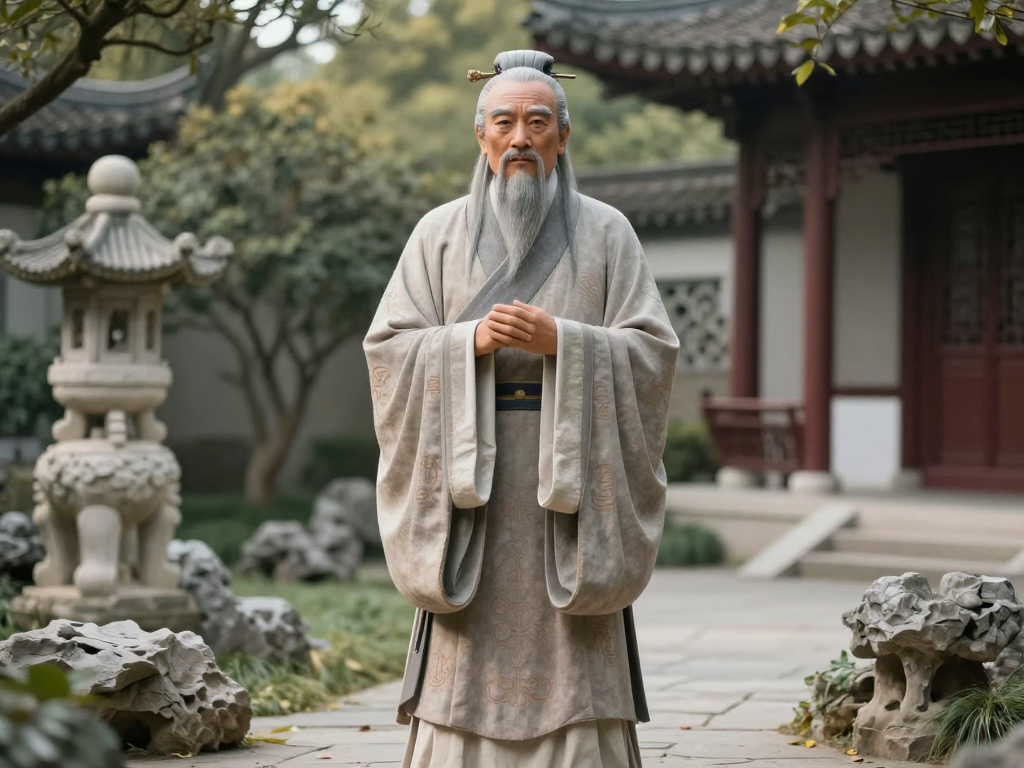
Born into minor nobility in a declining feudal state, Confucius spent his life pursuing a single, seemingly quixotic aim: to persuade rulers to govern through virtue rather than force, and to restore the moral fabric of a civilisation he believed was coming apart at the seams. He largely failed in his own lifetime. Within five centuries of his death, his teachings had become the official ideology of the world's largest empire — and for the next two thousand years, Confucianism would shape the education, government, family life, and moral imagination of more human beings than any other secular philosophy in history.
Confucianism
Confucius
East Asia · 551 – 479 BCE
Key Dates at a Glance
- 551 BCEBorn in Qufu, state of Lu (modern Shandong province), into the Kong clan of minor aristocratic descent
- c. 517 BCETraditional date of his meeting with Laozi in the Zhou capital; begins assembling disciples and teaching
- 497–484 BCEThe Great Wandering — thirteen years travelling the states of China seeking a ruler willing to implement his reforms; rejected at every court
- 484–479 BCEReturns to Lu; final years editing the classical texts and teaching; dies at age 72 or 73
- 136 BCEEmperor Wu of Han makes Confucianism the official state ideology; the imperial examination system — rooted in Confucian texts — begins its 2,000-year run
Historical & cultural background
A World Coming Apart — and Crying Out for Order
Confucius was born in 551 BCE into the Spring and Autumn period of the Zhou dynasty — an era whose deceptively pastoral name belies its reality of escalating interstate warfare, crumbling aristocratic ritual order, and the steady erosion of the feudal hierarchy that had given Chinese civilisation its structure for five centuries. The Son of Heaven in the Zhou capital retained only ceremonial authority; real power had fragmented among a dozen rival lords who waged increasingly brutal wars of annexation while paying lip service to the old ritual forms. Confucius watched this collapse with a grief that never left him.
The state of Lu, where Confucius was born and spent most of his life, was a small, relatively conservative kingdom in what is now Shandong province. It had a special significance: it was the home state of the Duke of Zhou, the great statesman and regent of the early Zhou dynasty whom Confucius regarded as the supreme embodiment of sage-kingship. Lu had preserved more of the old Zhou ritual traditions than any other state, and it was from this conservative, ritual-conscious environment that Confucius drew his deepest convictions about what was worth saving — and what needed to be recovered.
The Hundred Schools of Thought were responding to the same crisis Confucius faced, but from very different angles. While Laozi counselled withdrawal from the whole enterprise of civilised governance, and the Legalists argued that only ruthless law and punishment could hold society together, Confucius staked everything on a third possibility: that human beings were morally educable, that virtue was contagious, and that a ruler of genuine moral cultivation could transform society not through force or law but through the sheer exemplary power of his character. It was a profoundly idealistic position — and history, eventually, vindicated it on a scale he could never have imagined.
The Teacher Who Refused to Stop
Kong Qiu — later styled Kong Fuzi (Master Kong), Latinised by Jesuit missionaries in the sixteenth century as Confucius — was born in 551 BCE in the town of Zou in the state of Lu. His father, a minor military official of aristocratic descent, died when Confucius was three. He was raised in relative poverty by his mother, and his early life was marked by the particular combination of social aspiration, intellectual hunger, and experience of precarity that so often produces great moral teachers. He was largely self-educated, driven by an insatiable love of learning that he himself identified as his defining characteristic: "At fifteen, my mind was bent on learning. At thirty, I stood firm. At forty, I had no doubts. At fifty, I knew the decrees of Heaven. At sixty, my ear was an obedient organ. At seventy, I could follow what my heart desired, without transgressing what was right."
By his thirties, Confucius had established a school — the first in China to be open to all students regardless of social origin, charging only a token fee (traditionally described as a bundle of dried meat). This was itself a revolutionary act in a society where education was the exclusive preserve of the aristocracy. He gathered around him a core group of disciples — traditionally numbered at 72 particularly accomplished students, with 3,000 in total — of vastly different temperaments, social backgrounds, and abilities. His interactions with them, preserved in the Analects (Lunyu), reveal a teacher of extraordinary psychological sensitivity: he gave different answers to the same question asked by different disciples, always calibrating his response to the particular character and need of the questioner.
The most dramatic episode of his life was the Great Wandering: thirteen years (497–484 BCE) travelling from court to court across the states of Wei, Chen, Cai, Chu, and others, accompanied by a small band of loyal disciples, seeking a ruler who would actually implement his vision of virtuous governance. He was welcomed, flattered, occasionally given minor posts — and consistently passed over for real power. He was expelled from courts, lost in the wilderness, surrounded by hostile troops, and reduced to near-starvation. Through all of it, he maintained a composure that struck his disciples as almost superhuman. At one point, surrounded by enemies and running out of food, he sat playing his lute. When a disciple asked how he could remain so calm, he replied that a superior man's virtue is not contingent on circumstances. He was seventy when he finally returned to Lu, where he spent his last years editing the classical texts and teaching. He died in 479 BCE, believing himself a failure.
The Architecture of the Good Society
Where Laozi sought harmony with a cosmic order beyond human categories, Confucius sought harmony within human relationships themselves. His philosophy is irreducibly social: the self exists only in and through its relationships, and moral cultivation is inseparable from the cultivation of those relationships. At the centre of his vision stand the Five Constant Virtues (Wu Chang) — the moral architecture of the Confucian person and society:
The supreme virtue is Ren (仁) — benevolence or humaneness, the character formed by two elements meaning "person" and "two." It is, at its root, the quality of being fully human in relationship with another: the warmth, empathy, and active goodwill that makes genuine community possible. When a disciple asked Confucius for a single word that could serve as a guide for one's entire life, he answered: Shu — reciprocity. "What you do not want done to yourself, do not do to others." This formulation of the Golden Rule appears in the Analects five centuries before the Sermon on the Mount.
Li (禮) — ritual propriety — is equally central, and the most misunderstood of Confucius's concepts to modern Western readers. For Confucius, ritual was not empty formalism but the inherited wisdom of civilisation encoded in gesture, ceremony, and social form. Every bow, every form of address, every observance of mourning — these were the accumulated crystallisation of humanity's long learning about how to live together. To perform ritual well, with genuine feeling rather than mechanical compliance, was not constraint but liberation: it freed the person from the exhausting improvisation of social life and allowed genuine feeling to flow through a form that had been refined over generations.
Structuring all of this was the concept of the Junzi (君子) — the superior person, or gentleman, though Confucius made clear that the quality was a moral achievement available to anyone, not an accident of birth. The Junzi is not a saint; Confucius himself explicitly refused that title. The Junzi is a person who has cultivated virtue through sustained effort and self-examination, who has learned to place what is right above what is profitable, and whose very presence raises the moral tone of every situation he enters. This ideal — the cultivated moral exemplar as the engine of social transformation — is Confucius's most enduring gift to Chinese civilisation.
The Philosophy That Built an Empire — and Its Successors
The most consequential institutional expression of Confucian thought was the imperial examination system (keju), established in embryonic form under the Han dynasty and developed into its mature form by the Sui and Tang dynasties (7th century CE). For over 1,300 years — until its abolition in 1905 — this system required candidates for government office to master the Confucian classical canon and demonstrate their understanding in competitive written examinations open, in principle, to men of any social background. It was the world's first large-scale meritocratic bureaucracy, and it shaped the character of Chinese governance, scholarship, and social aspiration for more than a millennium.
The examination system's emphasis on classical literacy and moral cultivation produced a distinctive social type — the wenren, the literatus or scholar-official — who combined administrative competence with artistic refinement, calligraphic skill, and poetic sensibility. Chinese painting, poetry, and calligraphy were shaped for centuries by the aesthetic values of this class, for whom artistic practice was itself a form of moral cultivation. The great landscape painters of the Song dynasty, the poets of the Tang, the calligraphers who turned written characters into an art form of supreme refinement — all were formed by the Confucian educational tradition.
Beyond China, Confucianism spread to Korea (where it remains deeply embedded in social norms around education, family, and hierarchy), Japan (where it profoundly shaped the samurai ethos, the Meiji-era educational system, and corporate culture), Vietnam, and throughout the Chinese diaspora worldwide. The concept of the Confucian cultural sphere — East Asia as a region shaped by shared Confucian values of education, filial piety, social harmony, and meritocratic aspiration — has been influential in explanations of the region's extraordinary economic development in the twentieth century. Singapore's founding Prime Minister Lee Kuan Yew explicitly identified Confucian values as central to his nation's success.
The Teacher Whose Classroom Never Closed
Confucianism has survived everything history has thrown at it — including the most sustained assault in its history: the Chinese Communist revolution of the twentieth century, which identified Confucian hierarchies of family and authority as obstacles to socialist transformation. Mao Zedong launched a systematic campaign against "Confucius and Company" during the Cultural Revolution (1966–1976), destroying temples, burning texts, and persecuting scholars. Within a generation of Mao's death, the Communist Party itself was sponsoring Confucius Institutes worldwide and invoking the concept of "harmonious society" — drawn directly from Confucian political thought — as a national ideological goal.
Today there are over 500 Confucius Institutes operating in universities across more than 150 countries — a global soft-power network explicitly named after the sage, though their activities and political independence have been the subject of considerable international debate. In East Asian societies, Confucian values around education (the enormous investment families make in children's schooling), filial piety (the care of elderly parents as a moral obligation rather than a social choice), and social harmony remain powerful cultural forces, even where their traditional institutional expressions have been transformed.
In the global philosophical conversation, Confucianism has attracted growing scholarly and practical interest as a resource for thinking about relational ethics, civic virtue, and the moral foundations of community — precisely the questions that atomistic liberal individualism has found hardest to answer. The philosopher Tu Weiming and the "Boston Confucians" have developed a "third epoch" Confucianism that engages directly with democracy, human rights, and ecological responsibility. And in the Kong family's ancestral home in Qufu, Shandong — where the Temple, Cemetery, and Mansion of Confucius form a UNESCO World Heritage Site — descendants of the Master still live, more than eighty generations on, in an unbroken line that stretches back to the wandering teacher who believed, against all the evidence of his own lifetime, that virtue was enough.
Core teachings
- 1.Do not do to others what you would not want done to you.
- 2.Cultivate sincerity and integrity in small daily acts.
- 3.Honor family and community as the ground of a good life.
Suggested further reading
- The Analects (Annping Chin translation)
These summaries are educational and simplified — they cannot capture the depth of any tradition.