
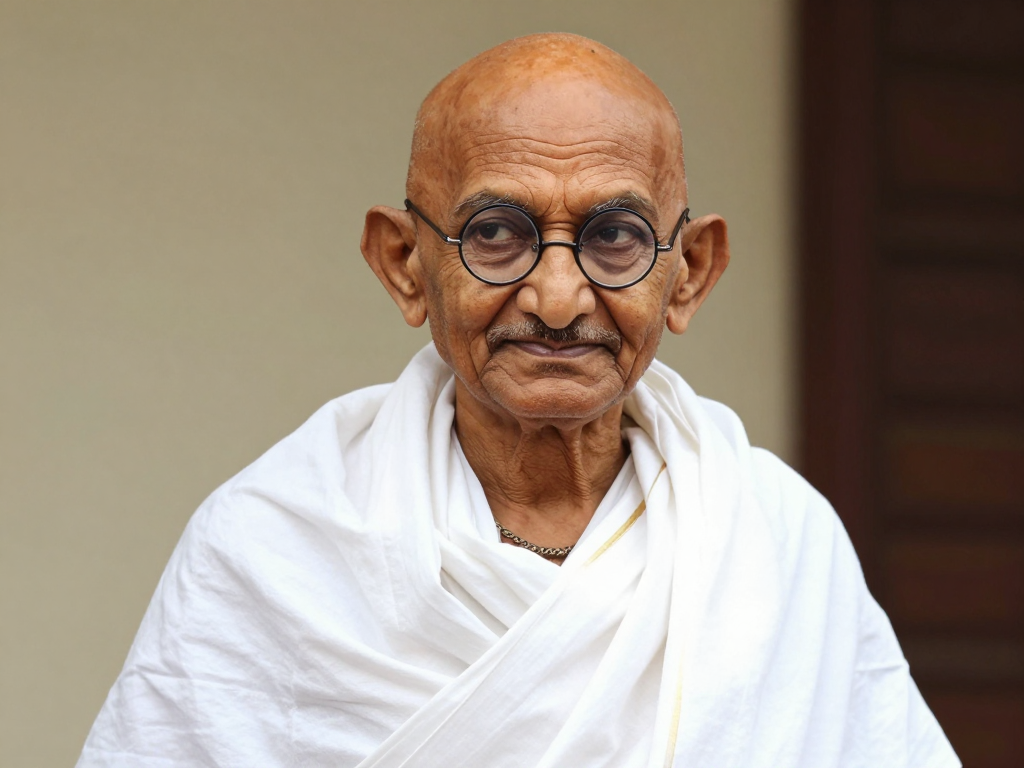
He was a shy, unremarkable young lawyer who failed his first case and was thrown off a train in South Africa for sitting in the wrong carriage. He became, over the next fifty years, the most consequential political innovator of the twentieth century — the architect of Satyagraha, the force of truth, which demonstrated to the world that an unarmed people committed to nonviolent resistance could defeat the largest empire in human history. He did not live to see the India he imagined. He was assassinated twelve days after independence. The questions his life poses have never been fully answered.
Hindu-inspired ethics
Mohandas K. Gandhi
South Asia · 1869 – 1948 CE
Historical & cultural background
The British Empire and the Age of Colonial Nationalism
Mohandas Gandhi was born on October 2, 1869, in Porbandar — a small princely state on the Kathiawar peninsula of Gujarat — into a world in which the British Empire was at the very height of its global reach. The Crown had assumed direct rule of India following the 1857 uprising just twelve years earlier; Queen Victoria would be proclaimed Empress of India in 1877. The subcontinent, with its 300 million people, its ancient civilisations, its agricultural wealth and raw materials, was the jewel in the imperial crown — and its systematic economic exploitation, which drained an estimated $45 trillion from India between 1765 and 1938 according to modern economic calculations, was the foundation upon which British industrial prosperity was built.
Gandhi grew up in a household shaped by the intersection of three religious streams that would mark his entire life. His mother Putlibai was deeply devout in the Vaishnava Hindu tradition and kept strict vegetarian vows; Jain merchant families of their acquaintance — Gujarat is India's most thoroughly Jain-influenced region — brought the philosophy of Ahimsa into his childhood as a lived practice rather than an abstract principle; and the Islam of neighbouring communities taught him that a single God required undivided devotion. He would carry all three streams — Hindu devotion, Jain nonviolence, and Abrahamic monotheism — into his politics.
The specific crucible that forged Gandhi's political identity was not India but South Africa. Sent there in 1893 to handle a commercial legal case for a Gujarati merchant firm, he was thrown off a first-class railway carriage at Pietermaritzburg by a white official despite holding a valid ticket. He spent the cold night on the station platform deciding whether to fight or retreat. He chose to fight — and spent the next twenty-one years in South Africa developing, testing, and refining the philosophy and practice of nonviolent resistance against the racial laws of the Natal and Transvaal governments. India would be the theatre of his greatest campaign; South Africa was the laboratory where the method was invented.
From Barrister to Bapu
The Mohandas Gandhi who sailed to London to study law in 1888 was a timid, overdressed young man from the provinces who was terrified of speaking in public and failed his first court case. He had married Kasturba at thirteen in an arranged marriage — the child-marriage custom he would later campaign against, while acknowledging with characteristic honesty that he had participated in it. He ate meat secretly in London to appear modern. He was, by his own later account, conventional to the point of nullity. What transformed him was the twenty-one-year encounter with South African apartheid — a system of racial degradation applied not only to Black Africans but to Indians, who occupied an intermediate humiliation in the colonial hierarchy.
In South Africa he developed the concept of Satyagraha — a word he coined himself, combining satya (truth) and agraha (firmness or force). Translated inadequately as "passive resistance" or "nonviolent resistance," Satyagraha was in fact neither passive nor merely nonviolent: it was an active, disciplined, courageous insistence on truth that sought to convert the opponent rather than defeat them. He led campaigns against the registration fingerprinting of Indians, against laws prohibiting Indian marriage rights, and against restrictions on free movement — going to jail repeatedly and drawing international attention to the conditions of South Africa's Indian community. He established the Phoenix Settlement near Durban and Tolstoy Farm near Johannesburg as communities of intentional simplicity where his followers could train in the discipline of Satyagraha.
When he returned to India in 1915 — at the invitation of his political mentor Gopal Krishna Gokhale — he was already internationally known. Rabindranath Tagore, who had just won the Nobel Prize in Literature, gave him the title Mahatma — Great Soul. Gandhi spent his first year in India travelling third class across the subcontinent, listening before speaking. Then, in 1917, he intervened in a dispute between indigo farmers and British planters in Champaran, Bihar — the first application of Satyagraha on Indian soil. It worked. Over the next three decades, building the Indian National Congress into a mass movement that reached peasants and urban poor as no political organisation had before, he would use the method at a scale that eventually made continued British rule untenable.
Satyagraha, Ahimsa, and the Experiments with Truth
Gandhi called his autobiography The Story of My Experiments with Truth — a title that reveals the empirical, provisional, self-revising character of his thought. He was not a systematic philosopher; he was a practitioner who drew ideas from every tradition he encountered, tested them in campaigns and in his own body, and revised them honestly when they failed. The result was a body of thought that is inseparable from a life of practice — and correspondingly difficult to separate from that life and apply as an abstract system.
Satyagraha — the force of truth — was his central political and philosophical contribution. Its logic rested on three interconnected claims: that truth is ultimately one and accessible to all, that violence corrupts the truth-seeker as much as it harms the opponent, and that the willingness to suffer rather than inflict suffering is a form of moral power that can melt even a hardened oppressor's will. A Satyagrahi does not seek to win; they seek to convert. They hold open the possibility of the opponent's redemption even while refusing to accept injustice. This is why Gandhi insisted that hatred of the British was incompatible with Satyagraha: he was not opposing British people but British policy, and he wanted them to leave India as friends.
Ahimsa — nonviolence — was the indispensable foundation, drawn directly from Jain ethics and from the Bhagavad Gita's concept of action without violence toward any living being. But Gandhi extended it in a direction the Jain tradition had not: into political confrontation. The Jain ahimsa counselled withdrawal from harm; Gandhi's ahimsa demanded engagement with injustice. The monk sweeps the path before him to avoid harming insects; the Satyagrahi marches into the path of police batons. Both are expressions of ahimsa; Gandhi's version required a form of courage that pure withdrawal does not.
His concept of Swaraj — self-rule — was political (independence from Britain) but also and more fundamentally personal: mastery of the self, freedom from the compulsions of desire, fear, and habit. You cannot win freedom for a nation, he argued, if you have not first won freedom within yourself. This is why he practised and publicly discussed celibacy, dietary discipline, manual labour, and fasting not as personal eccentricities but as political preparations — the training of the self toward the kind of uncoerced action that Satyagraha requires. The charkha (spinning wheel) was the symbol of this integration: spinning cotton was simultaneously an act of economic resistance, a meditative practice, and a lesson in the dignity of manual labour for an educated class that had been taught to despise it.
The Liberation of a Subcontinent — and Its Contradictions
On August 15, 1947, India achieved independence from British rule — the largest transfer of power in world history, accomplished primarily without armed revolution. The campaign Gandhi led over thirty years had made continued British rule morally untenable before it made it militarily or economically impossible. This was the proof of concept for Satyagraha at civilisational scale: that a colonial power could be compelled to withdraw not by matching its violence but by refusing to legitimise it. The British knew they were leaving; what Gandhi's movement did was determine the terms on which they left and accelerate the inevitable.
The global consequences were immediate and enormous. The independence of India demonstrated that the largest empire in history was not invincible — and that nonviolence was not merely a moral preference but a practical method of political change. Within a decade, independence movements across Africa, Asia, and the Caribbean were citing Gandhi; within two decades, Martin Luther King Jr. had built his entire philosophy of the American civil rights movement on Gandhi's foundations, explicitly acknowledging the debt. Nelson Mandela, who spent twenty-seven years in prison before leading South Africa out of apartheid, drew directly on Gandhi's South African legacy — particularly resonant given that Gandhi had himself developed Satyagraha on South African soil.
The independence Gandhi delivered came, however, at a catastrophic cost he could neither prevent nor accept. The Partition of India into India and Pakistan — agreed between the Congress leadership, the Muslim League, and the departing British — produced the largest forced migration in history: between 12 and 20 million people displaced, between 200,000 and 2 million killed in communal violence. Gandhi had opposed Partition to the last; he spent independence day not in Delhi celebrating but in Calcutta attempting to calm communal riots by fasting. The contradiction between his life's achievement and its attendant catastrophe — independence and Partition as inseparable twins — was the grief of his final months and remains one of the most sobering lessons in the limits of any individual's power to shape history.
The Unfinished Experiment
Nathuram Godse shot Gandhi three times in the chest at point-blank range during a prayer meeting at Birla House, New Delhi, on the evening of January 30, 1948. Godse was a Hindu nationalist who believed Gandhi had betrayed Hindus by his insistence on Muslim equality and his opposition to the full incorporation of Muslim-majority territories into India. Gandhi was seventy-eight years old. His last words, as he fell, were reported as "Hey Ram" — "O God." The man who had preached nonviolence for half a century was killed by political violence twelve days after the nation he had liberated came into being.
The contradictions and controversies that surround Gandhi's legacy are substantial, and intellectual honesty requires engaging with them. His early writings in South Africa expressed attitudes toward Black Africans that were condescending at best and racist at worst — attitudes he apparently never fully recanted, though his political partnership with Black South African leaders grew over time. His experiments in celibacy in old age — sleeping beside young women to test his self-mastery — were, by any modern standard, troubling. His handling of his son Harilal's personal crises was often harsh to the point of cruelty. His position on Partition, while morally consistent, made no practical difference to its outcome. The Mahatma was, like every figure in this series, a full human being — and the fuller the picture, the more remarkable rather than less it becomes that someone so human achieved so much.
In the twenty-first century, with democracies eroding, inequalities widening, and the planet warming, the central questions Gandhi posed have lost none of their urgency. Can political change be achieved without violence? Can an economy be organised around need rather than greed? Can a person be simultaneously politically effective and personally free — free from the accumulated compulsions of fear, desire, and habit that ordinarily drive political actors? His answer to all three was yes — demonstrated, imperfectly and magnificently, in the life he lived. Every October 2nd, his birthday is observed as the International Day of Nonviolence — a date the United Nations established in 2007, acknowledging that the experiment he began in a South African railway station in 1893 is still, and necessarily, in progress.
Core teachings
- 1.Satyagraha — the active, disciplined insistence on truth — seeks to convert opponents rather than defeat them.
- 2.Ahimsa (nonviolence) is not passive withdrawal but courageous engagement with injustice without inflicting harm.
- 3.Swaraj (self-rule) begins with mastery of the self; you cannot free a nation without first freeing yourself from fear and desire.
- 4.Means and ends are inseparable: the method of achieving a goal must embody the values of the goal itself.
Suggested further reading
- The Story of My Experiments with Truth
These summaries are educational and simplified — they cannot capture the depth of any tradition.