
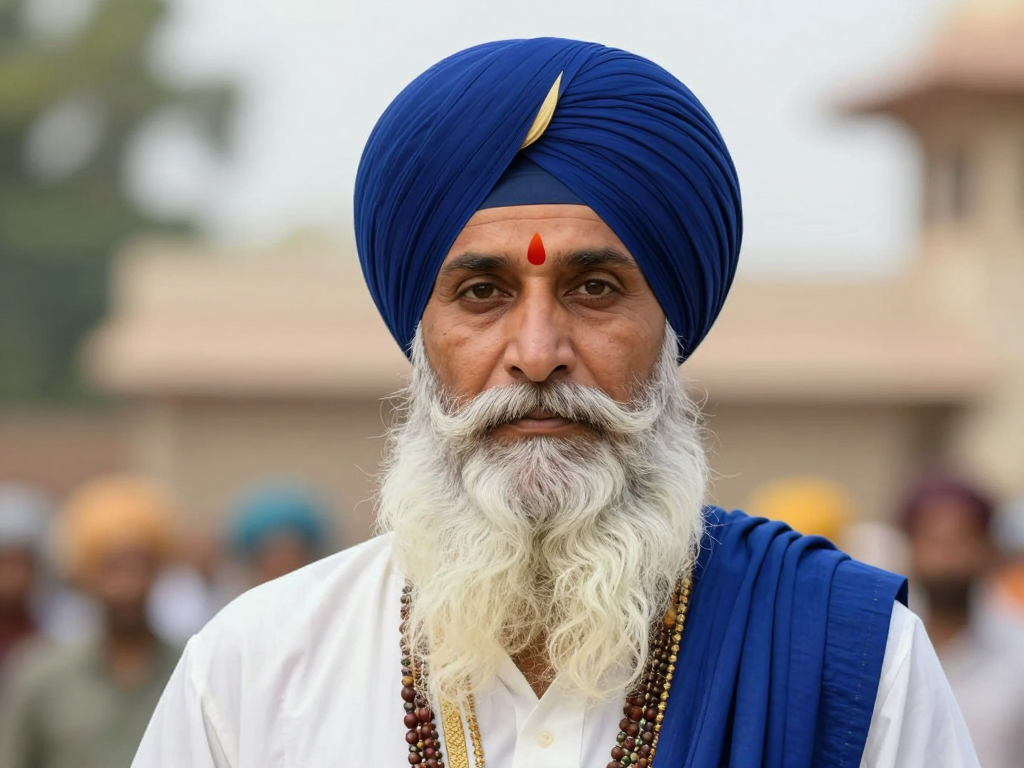
Born in 1469 in the Punjab — a land caught between the fading Sultanate of Delhi and the rising tide of Mughal power — Guru Nanak Dev Ji emerged from a moment of extraordinary religious and political upheaval to proclaim a simple, revolutionary truth: there is one God, formless and beyond all names; all human beings are equal before that God; and the path to union with the Divine runs not through ritual, caste, or priestly authority but through Nam Simran — the loving remembrance of the Divine Name. From that seed grew Sikhism, today the world's fifth-largest religion.
Sikhism
Guru Nanak
South Asia · 1469 – 1539 CE
Key Dates at a Glance
- 1469 CEBorn at Rai Bhoi di Talwandi (now Nankana Sahib, Pakistan) to Mehta Kalu and Mata Tripta
- c. 1499 CEThe divine experience at the Vein River — three days in the presence of God; emerges declaring 'There is no Hindu, there is no Muslim'
- 1499–1524 CEThe four Udasis (sacred journeys) — travelling east to Hindu sacred sites, south to Sri Lanka, north to the Himalayas and Tibet, west to Mecca and Baghdad
- c. 1521 CEWitnesses the sack of Saidpur by Babur's forces; composes the Baburnamas — the first political poetry in Punjabi literature
- 1539 CESettles at Kartarpur; establishes the Sangat (congregation) and Langar (free community kitchen); appoints Guru Angad as successor; passes away
Historical & cultural background
The Punjab Between Two Worlds
The Punjab of Guru Nanak's birth was one of the most religiously and culturally contested landscapes on earth. Situated at the crossroads of South Asian civilisation — the great plain drained by the five rivers from which it takes its name — it had been invaded, converted, and re-converted for centuries. The Delhi Sultanate, a succession of Muslim dynasties that had ruled northern India since 1206, was in its final, fractured decades. In 1526, just decades after Guru Nanak's spiritual awakening, Babur would defeat the last Lodi sultan at Panipat and establish the Mughal Empire — a dynasty that would define the subcontinent's political and cultural life for the next three centuries.
Into this world of political instability, Guru Nanak was born into the complex religious plurality of the Punjab. The majority of the population was Hindu, with deep Brahmanical traditions of caste hierarchy, Vedic ritual, and temple worship. A substantial and socially dominant Muslim minority — including the ruling class — practised Islam, ranging from the orthodoxy of the ulema to the ecstatic mysticism of the Sufi orders, whose shrines dotted the Punjab landscape and whose message of divine love and unity resonated powerfully across religious boundaries. The Bhakti movement — the great wave of devotional Hinduism that had been sweeping across India since the 6th century — was in full flood, with saint-poets like Kabir, Ravidas, and Mirabai singing in vernacular languages of a God beyond caste and ritual. Guru Nanak stood at the confluence of all these streams.
It was also a world of intense social injustice. The caste system determined every aspect of a Hindu's birth, occupation, and spiritual eligibility — the lowest castes were excluded from temples, from learning, and from the very possibility of ritual purity. Muslim rulers extracted tribute from Hindu subjects and periodically enforced conversion. The ordinary people of the Punjab — farmers, artisans, weavers — lived between two religious establishments neither of which had been designed with their liberation in mind. It was precisely to this world, and to these people, that Guru Nanak addressed his most urgent message.
The Wandering Guru of a Thousand Roads
Nanak was born on 15 April 1469 in the village of Rai Bhoi di Talwandi — now known as Nankana Sahib, in present-day Pakistan — to a Hindu family of the Khatri mercantile caste. From childhood, the accounts preserved in the Janamsakhis (birth stories) describe a child of unusual spiritual depth: he refused to wear the sacred thread at the Upanayana ceremony, declaring that the true thread must be woven from the cotton of compassion and tied with the knot of contentment. He spent long hours in meditation and discourse with wandering sadhus. His father, hoping to ground him in practical life, sent him to work as an accountant in the state granary at Sultanpur — where he met his lifelong companion and musician, the Muslim minstrel Mardana, with whom he would travel for the rest of his life.
Around 1499, at the age of thirty, Nanak went to bathe in the Vein River and did not return for three days. When he emerged, he was a changed man. He had been, he said, in the presence of God, given a cup of nectar to drink and commanded to go into the world and teach the repetition of the Divine Name and the practice of charity and ritual bathing — the spiritual cleansing of the interior life. The first words he spoke upon his return were the declaration that became the founding utterance of Sikhism: "There is no Hindu, there is no Muslim."
What followed were the four Udasis — the great sacred journeys that took Guru Nanak, accompanied always by Mardana's music, to every corner of the known world. He travelled east to Haridwar, Varanasi, Gaya, and Puri, engaging with Hindu pandits and Brahmin priests. He travelled south as far as Sri Lanka, to Rameshwaram and beyond. He went north through the Himalayas, to Ladakh, Tibet, and the great mountain passes. And — most dramatically — he went west: to Mecca, to Medina, to Baghdad, to Persia. At every stopping point he debated, sang, taught, and challenged — confronting both the caste orthodoxy of Brahminism and the exclusivism of Islamic religious law with the same fundamental question: does God truly favour one people, one ritual, one religion over another? His travels, covering an estimated 28,000 kilometres on foot over twenty-five years, remain one of the most extraordinary journeys in the history of religion.
One God, One Humanity, One Table
Guru Nanak's theology begins with a symbol: ੴ (Ik Onkar) — "One God" or "God is One" — the opening of the Mool Mantar, the root declaration of Sikh faith. Written in Gurmukhi script, it is the first composition in the Guru Granth Sahib and the most fundamental statement of Sikh theology. God, for Guru Nanak, is Nirankar — formless, beyond gender, beyond image, beyond the limitations of any single religious tradition's conception. God is equally the God of Hindus and Muslims, of high castes and untouchables, of men and women. Nanak is emphatic: any God who favours one people over another is not God but an idol.
These three imperatives — meditate, work honestly, share — constitute the practical architecture of the Sikh life. Together they form a seamless integration of the spiritual and the worldly that distinguishes Sikhism from traditions that counsel withdrawal from society. For Guru Nanak, the saint is not the one who retreats to the forest; it is the Grishti — the householder — who engages fully with the world, earns by honest labour, and gives generously. The monastery and the marketplace are not in competition; they are the same arena of spiritual practice.
Guru Nanak's most radical social teaching was his absolute rejection of caste. At a time when the caste system determined every aspect of Hindu religious life — who could enter a temple, who could study scripture, whose touch was ritually polluting — Nanak declared it spiritually meaningless. "Caste and social position mean nothing," he wrote in the Guru Granth Sahib. "It is the one God who gives breath and sustenance to all." This conviction was embodied in the institution of the Langar — the free community kitchen attached to every Gurdwara (Sikh place of worship), where people of all castes, classes, and religions sit together in a single row and eat the same food. In sixteenth-century India, this was a revolutionary act of social equality with no parallel anywhere in the world.
A New People and a New Scripture
Guru Nanak did not merely found a religion; he founded a community — the Panth — and gave it the institutions that would sustain it across five centuries of extraordinary trial. The Sangat (congregation), the Langar (free kitchen), and the tradition of Kirtan (devotional music) that he and Mardana established were the three pillars of Sikh communal life from the very beginning. He also commissioned the creation of the Gurmukhi script — a refined form of an existing script — in which Punjabi was written, giving the community its own literary and scriptural language independent of both Sanskrit and Persian.
The tradition Guru Nanak began was continued and deepened by nine successor Gurus. The fifth Guru, Arjan Dev Ji, compiled the hymns of the first five Gurus and prominent Bhakti and Sufi poet-saints — including Kabir, Ravidas, Namdev, and Sheikh Farid — into the Adi Granth (1604 CE), the first edition of what would become the eternal living Guru of the Sikhs. The tenth Guru, Gobind Singh Ji, founded the Khalsa (the community of the pure) in 1699 — a brotherhood and sisterhood of initiated Sikhs who adopted the Five Ks (Panj Kakars) as visible markers of identity and committed themselves to the defence of the weak and the pursuit of justice. He also declared that after his death, the scripture itself — henceforth the Guru Granth Sahib — would be the living, eternal Guru of the Sikh community. It remains so to this day.
The Sikh community produced, under the pressure of Mughal persecution and later Afghan invasion, a warrior tradition of extraordinary courage — embodied in the concept of Sant-Sipahi, the saint-soldier who combines spiritual depth with physical courage. The four Sahibzade (sons of Guru Gobind Singh), who were martyred rather than convert to Islam — the youngest two bricked alive in a wall — remain among the most venerated figures in Sikh history. The Golden Temple at Amritsar (Harmandir Sahib), built by Guru Arjan Dev Ji with its four doors opening in all four directions as a symbol of welcome to all humanity, is among South Asia's most visited sites of pilgrimage and one of the world's most architecturally magnificent sacred spaces.
Twenty-Five Million Sikhs and a Global Kitchen
Sikhism today counts approximately 25–30 million adherents worldwide, making it the world's fifth-largest religion. The majority live in the Punjab — divided since 1947 between India and Pakistan — but the Sikh diaspora has established significant communities in the United Kingdom, Canada, the United States, Australia, and East Africa. In every city where Sikhs have settled, the Gurdwara and its Langar have become community anchors — and in many cases, vital food relief operations. During the COVID-19 pandemic, Sikh organisations worldwide distributed millions of free meals to isolated and vulnerable people, drawing international attention to the tradition of seva that Guru Nanak had placed at the heart of Sikh practice five centuries earlier.
The Golden Temple at Amritsar — completed under Guru Arjan Dev Ji in 1604 and rebuilt in its current gold-covered form in the early 19th century — receives an estimated 100,000 visitors per day, making it one of the most visited places of worship on earth, surpassing the Vatican and many other sacred sites in footfall. The Langar attached to it serves over 100,000 free meals daily — entirely through volunteer labour and community donation — a living, daily enactment of Guru Nanak's insistence that the path to God runs through the service of humanity.
In political life, Sikhs have punched far above their demographic weight. In Canada, Sikhs have served at the highest levels of federal government. In the United Kingdom, Sikhs have been decorated in every major military conflict since the Victorian era and are present across Parliament and the professions. In India, Manmohan Singh — a Sikh economist — served as Prime Minister for a decade (2004–2014). The turban, the kirpan, and the unshorn hair of the Khalsa Sikh have become, in the twenty-first century, the subject of legal and constitutional debates in France, Canada, and elsewhere — debates about religious freedom, identity, and pluralism that Guru Nanak himself anticipated when he declared, five hundred years ago, that the externals of religion are not its essence, and that God looks not at the garment but at the heart within.
Core teachings
- 1.All human beings are equal in dignity.
- 2.Serve others — the langar (shared meal) is open to everyone.
- 3.Work honestly and share what you have.
Suggested further reading
- Selections from the Guru Granth Sahib
These summaries are educational and simplified — they cannot capture the depth of any tradition.