
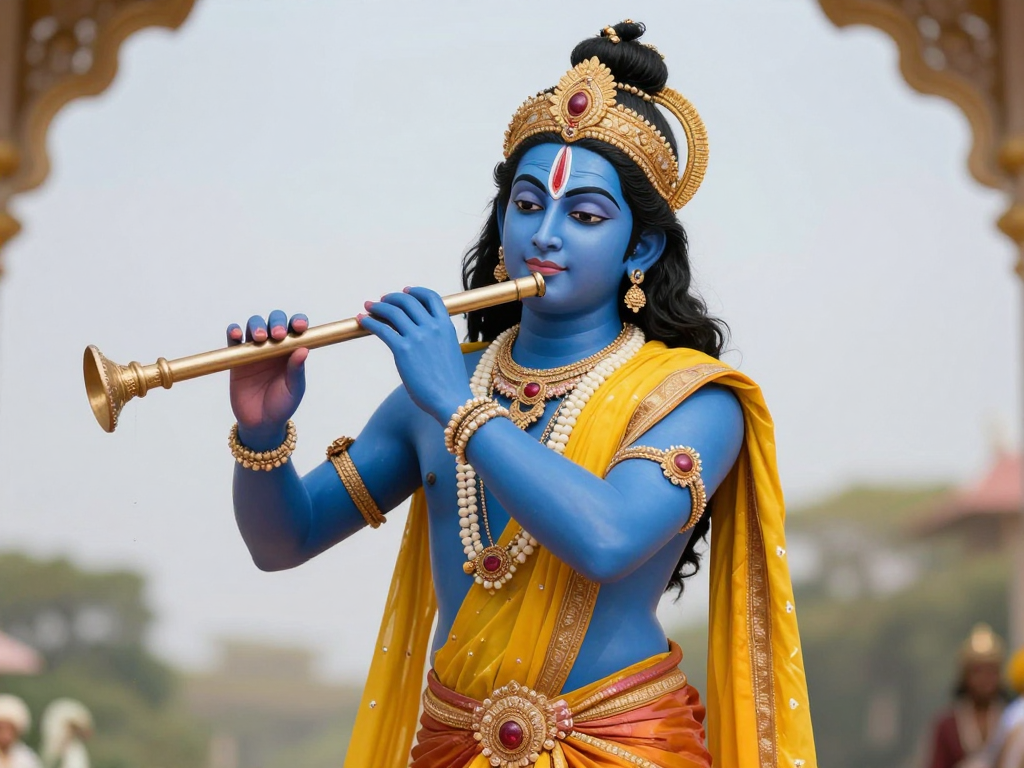
Among the most beloved figures in the entire history of religion, Krishna defies easy categorisation. He is simultaneously a historical hero of ancient India's epic age, the eighth avatar of the great god Vishnu, a divine child whose miracles enchanted the cowherds of Vrindavan, and the supreme philosophical voice of the Bhagavad Gita — perhaps the most widely read and commented-upon spiritual text in the world after the Bible. For nearly a billion Hindus, he is nothing less than the fullest expression of the Divine in human form.
Hinduism
Krishna
South Asia · Traditional figure of ancient India
Key Dates at a Glance
- c. 3200–1500 BCETraditional dating of Krishna's earthly life; modern scholarly estimates place the Mahabharata world in the late Vedic period
- c. 400 BCE–400 CEComposition of the Mahabharata in its present form, embedding the Bhagavad Gita as its philosophical centrepiece
- c. 4th–6th C. CEEmergence of the Bhagavata Purana tradition; Krishna devotionalism (Vaishnavism) established as a major theological school
- c. 12th C. CEJayadeva's Gita Govinda; flowering of Krishna bhakti poetry across South and North India; Vaishnava saint-poets reshape Hindu devotion
- 1966 CEBhaktivedanta Swami founds ISKCON (the Hare Krishna movement) in New York; Krishna devotion goes global
Historical & cultural background
Ancient India and the Epic Age
Krishna belongs to the world of the Mahabharata — the vast Sanskrit epic whose composition spans roughly eight centuries (c. 400 BCE to 400 CE) but whose narrative is set in the twilight of a heroic age, the Dvapara Yuga, when gods still walked among men. The subcontinent of that era was a complex mosaic of kingdoms, republics, and tribal confederacies across the Ganges plain and beyond, governed by a warrior aristocracy (Kshatriyas) whose codes of honour, duty, and warfare the Mahabharata anatomises with extraordinary psychological depth.
The religious landscape was equally complex. The ancient Vedic tradition, centred on sacrificial ritual and the great hymns of the Rigveda, was giving way — or rather, expanding and transforming — into the more philosophically oriented tradition of the Upanishads, which probed the nature of the self (atman) and ultimate reality (Brahman). Simultaneously, the bhakti movement — devotional worship directed toward a personal deity — was beginning its long rise, eventually becoming the dominant form of popular Hinduism across the subcontinent. Krishna would become its supreme object of devotion.
Historically, scholars identify a real figure — a chieftain of the Yadava clan, likely based in the Mathura–Vrindavan region of what is now Uttar Pradesh — at the root of the Krishna tradition. Over centuries, this human hero was gradually elevated, through the theological work of Vaishnava thinkers and the devotional poetry of the saint-poets, into the purna avatar: the complete and full descent of God into the world. The Bhagavata Purana (c. 9th–10th century CE) gave that elevation its definitive literary form, presenting the life of Krishna with a richness, beauty, and theological depth unmatched in Hindu literature.
From Vrindavan to Kurukshetra
The life of Krishna as told across the Mahabharata, the Bhagavata Purana, and the Harivamsa unfolds in three mythological landscapes of extraordinary power. The first is Mathura, where he is born in a prison cell to Devaki and Vasudeva, under sentence of death from his uncle King Kamsa — who has been warned by prophecy that his sister's eighth child will destroy him. His father carries the infant across the flooding Yamuna River at midnight to safety in the village of Gokul, where he is raised by the cowherd Nanda and his wife Yashoda. The parallels with other miraculous birth-and-rescue narratives from world mythology are unmistakable, and have long fascinated comparative religion scholars.
The second landscape is Vrindavan — the forest of sacred basil trees, the banks of the Yamuna, the world of the cowherds (gopas) and cowherdesses (gopis). This is the setting for the most beloved cycle of Krishna stories: the playful, mischievous child who steals butter, who dances on the hood of the serpent Kaliya, who lifts Mount Govardhan on his little finger to shelter the villagers from Indra's wrath. And above all, the young flute-playing lover whose music draws all beings toward him — the rasa lila, the cosmic dance in which Krishna multiplies himself so that every gopi dances with him simultaneously. In Vaishnava theology, this is not sensual escapism but the deepest symbol of the soul's longing for union with the Divine.
The third landscape is Kurukshetra — the battlefield where the two great dynasties of the Mahabharata, the Pandavas and the Kauravas, meet in an apocalyptic eighteen-day war. Here Krishna serves as the charioteer of the Pandava hero Arjuna, who breaks down at the sight of his kinsmen arrayed against him and refuses to fight. Krishna's response — the Bhagavad Gita — is among the world's most profound meditations on duty, action, knowledge, devotion, and the nature of the self. Across eighteen chapters, Krishna reveals himself progressively, culminating in the awe-inspiring Vishvarupa: the cosmic form in which Arjuna sees the entire universe contained within the body of his charioteer.
The Song of God
The Bhagavad Gita — 'Song of the Lord' — is Krishna's supreme philosophical gift to the world. Delivered on a battlefield, it addresses a universal human crisis: what to do when duty conflicts with feeling, when action is unavoidable but its consequences are unbearable. Krishna's answer unfolds along three great paths to liberation — the Yoga Triad — which together constitute a comprehensive philosophy of human life.
Jnana Yoga — the path of knowledge — holds that suffering arises from ignorance of the true nature of the self. The atman, Krishna teaches, is eternal, unborn, and indestructible: 'The soul is never born nor dies at any time. It has not come into being, does not come into being, and will not come into being. It is unborn, eternal, ever-existing, and primeval.' Death destroys only the body — the self is beyond all change.
Karma Yoga — the path of selfless action — is perhaps the Gita's most practically influential teaching. Act, Krishna urges, but without attachment to results: 'You have a right to perform your prescribed duties, but you are not entitled to the fruits of your actions. Never consider yourself the cause of the results of your activities, and never be attached to not doing your duty.' This concept of nishkama karma — desireless action — has profoundly influenced thinkers from Mahatma Gandhi (who called the Gita his 'eternal mother') to modern management philosophy.
Bhakti Yoga — the path of devotion — is presented as the highest and most accessible of the three. In the Gita's twelfth chapter, Krishna declares that those who worship him with single-minded, loving devotion are dearest to him. This elevation of personal love for God as a spiritual path in its own right unleashed one of history's greatest religious poetry traditions — the bhakti movement that swept across India from the 6th to the 17th centuries in wave after wave of saint-poets singing of their longing for Krishna.
The God Who Pervades a Civilisation
Krishna's influence on Indian civilisation is so total and so ancient that attempting to measure it is like attempting to measure the influence of colour on painting. He has shaped classical music (dhrupad, khayal, carnatic devotional genres are saturated with Krishna imagery), dance (Bharatanatyam, Odissi, Manipuri, and Kathak all have rich Krishna repertoires), visual art (the Pahari miniature paintings of the 17th–18th centuries depicting the Vrindavan legends are among the high points of Indian artistic achievement), architecture (temples at Vrindavan, Mathura, Puri, Udupi, and Nathdwara are among India's most visited pilgrimage sites), and literature across virtually every Indian language.
The bhakti movement that Krishna inspired is perhaps his most consequential cultural legacy. Beginning in the Tamil country with the Alvars (6th–9th centuries CE), sweeping through Karnataka with Purandaradasa, Maharashtra with Dnyaneshwar and Tukaram, Bengal with Chaitanya Mahaprabhu, and North India with Mirabai, Surdas, and Tulsidas, the bhakti poets composed in vernacular languages — bypassing Sanskrit and its priestly gatekeepers — to create a democratic, emotionally direct, socially inclusive devotion accessible to all, regardless of caste or gender. Mirabai, a Rajput princess who sang of Krishna as her true husband and defied every social convention in his name, remains one of the most beloved poets in Indian history.
The Bhagavad Gita has generated more commentaries than perhaps any other text in world literature. Adi Shankaracharya (8th century), Ramanuja (11th–12th century), Madhvacharya (13th century), and countless others built entire philosophical systems upon it. In the modern period, Mahatma Gandhi turned to it as his guide to non-violent resistance; Bal Gangadhar Tilak used it to inspire Indian nationalism; J. Robert Oppenheimer, watching the first nuclear test at Trinity, quoted its eleventh chapter: 'Now I am become Death, the destroyer of worlds.'
The Eternal Beloved in a Contemporary World
Krishna's global reach expanded dramatically in the twentieth century. In 1966, A.C. Bhaktivedanta Swami Prabhupada — a seventy-year-old Bengali monk who arrived in New York with seven dollars and a trunk of books — founded the International Society for Krishna Consciousness (ISKCON), the Hare Krishna movement. Within a decade, saffron-robed devotees were chanting the Mahamantra on the streets of major cities worldwide, and the Bhagavad Gita As It Is had become one of the most distributed books in the world. Today ISKCON operates over 600 temples across 60 countries, and its Food for Life programme — rooted in the Vaishnava principle that feeding others is an act of worship — distributes more than two million free meals daily, making it the world's largest plant-based food relief programme.
In India, Krishna's pilgrimage sites — Vrindavan, Mathura, Dwarka, Nathdwara — draw tens of millions of visitors each year. The festival of Janmashtami (Krishna's birthday), marked by midnight celebrations, fasting, devotional singing, and the formation of human pyramids to reach pots of curd hung high in the air (re-enacting the young Krishna's legendary butter-stealing), is one of the most joyous and widely observed festivals in the Hindu calendar.
For philosophers and seekers worldwide, the Bhagavad Gita continues to offer what Aldous Huxley called 'the most systematic spiritual statement of the Perennial Philosophy' — a vision of human existence, divine love, and selfless action that speaks with undimmed urgency to lives still torn between duty and desire, action and contemplation, the human and the eternal. In the figure of Krishna — simultaneously cowherd and cosmic lord, lover and philosopher, trickster and teacher — Hinduism has given the world one of its most inexhaustibly rich images of the Divine.
Core teachings
- 1.Act with devotion, not for reward.
- 2.See the same essence in all beings.
- 3.Steady the mind through practice and surrender.
Suggested further reading
- The Bhagavad Gita (Eknath Easwaran translation)
These summaries are educational and simplified — they cannot capture the depth of any tradition.