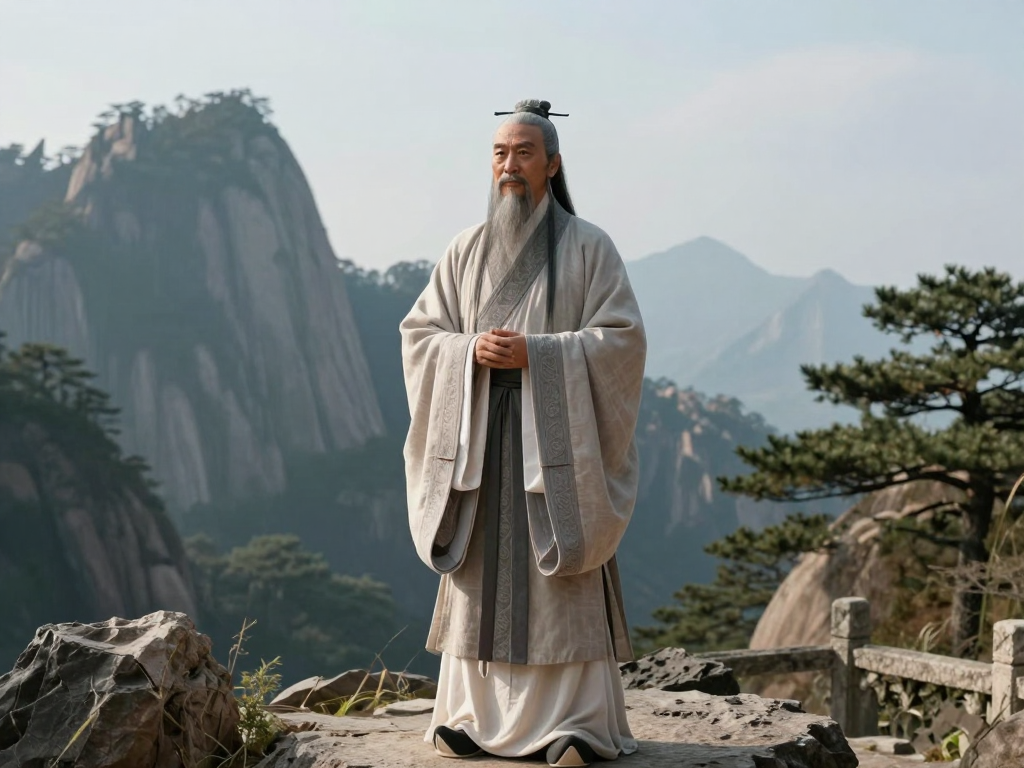
Somewhere around the sixth century BCE, an old archivist of the Zhou dynasty grew weary of a civilisation in decline and rode west on a water buffalo toward the frontier passes of China. A border guard, recognising wisdom in the traveller, asked him to write down his teachings before he disappeared. The result — five thousand characters on the nature of the Tao, the unnameable source and sustainer of all things — became the Tao Te Ching: the most translated book after the Bible, and the founding text of one of humanity's most quietly radical philosophies.
Taoism
Laozi
East Asia · Traditionally c. 6th century BCE
Key Dates at a Glance
- c. 601–531 BCETraditional dates of Laozi's life; contemporary of Confucius according to Sima Qian's Historical Records
- c. 6th–4th C. BCEComposition of the Tao Te Ching; the Guodian bamboo slips (c. 300 BCE) preserve the earliest known manuscript
- c. 3rd–2nd C. BCEZhuangzi expands Taoist philosophy; Taoism adopted as governing philosophy during the early Han dynasty (Huang-Lao school)
- 142 CEZhang Daoling receives a revelation from the deified Laozi; founding of the Way of the Celestial Masters — organised Taoist religion begins
- 666 CETang Emperor Gaozong deifies Laozi as the 'Most High Lord Lao' (Taishang Laojun); Taoism becomes an imperial religion
Historical & cultural background
The Warring States and the Crisis of Chinese Civilisation
Laozi emerged from one of China's most turbulent and intellectually fertile periods. The Zhou dynasty (1046–256 BCE), which had once united the Central Plains under a stable feudal order legitimised by the concept of the Mandate of Heaven (Tianming), was fracturing. Regional lords who had once been loyal vassals were becoming autonomous kings; constant warfare between rival states was grinding down the peasantry; the old ritual and ceremonial order that Confucius would spend his life trying to restore was visibly collapsing. It was an age of catastrophe — and, as such ages tend to produce, an age of extraordinary thought.
This was the Hundred Schools of Thought era — the remarkable Chinese Axial Age in which Confucianism, Taoism, Legalism, Mohism, and a dozen other schools competed to diagnose what had gone wrong with civilisation and prescribe its remedy. Confucius, a near-contemporary of Laozi according to tradition, argued that the answer lay in the meticulous recovery of ritual propriety (li), moral cultivation (ren — benevolence), and the restoration of proper relationships between ruler, minister, father, son, husband, and wife. The Legalists argued that only strict law, enforced impartially, could hold society together. The Mohists promoted universal love and consequentialist ethics.
Laozi's response was the most radical of all. He did not argue for better government, better laws, or more ritual. He argued that the fundamental problem was interference itself — the human insistence on imposing artificial order on a reality that already possessed a deeper, more subtle order of its own. The Tao — the Way — was not something that needed to be constructed or recovered. It was the ground of all being, flowing through everything that existed, and the task of the sage was not to act upon it but to align with it. This was the birth of wu wei — non-action, or more precisely, action so perfectly attuned to the natural flow of things that it leaves no trace of effort.
The Old Master Who Vanished
The biography of Laozi — whose name means simply 'Old Master' or 'Old Child,' with a deliberate paradox at its heart — is more legend than documented history, and Taoism has always been at ease with that. The earliest substantial account comes from Sima Qian's Records of the Grand Historian (c. 100 BCE), written some four to five centuries after Laozi's supposed lifetime. Even Sima Qian, China's first great historian, presents the figure with unusual tentativeness, recording several conflicting traditions about who Laozi was, when he lived, and whether he existed at all as a single person.
The traditional account identifies him as Li Er (also called Li Dan), an archivist or keeper of records at the royal Zhou court in Luoyang. There he is said to have spent decades among the dynasty's accumulated chronicles, ritual manuals, and historical documents — absorbing the long memory of Chinese civilisation while watching, day by day, its outward order crumble. One famous tradition recounts a visit from a younger Confucius, who came seeking instruction on ritual and is said to have departed shaken, comparing the old archivist to a dragon that 'rides upon the clouds and wind' and cannot be grasped.
The most enduring image is of his departure. Disillusioned by the decline he saw all around him, Laozi mounted a water buffalo and rode west toward the frontier passes that marked the edge of the civilised world. At the Hangu Pass, the gatekeeper Yinxi — recognising that a great sage was about to vanish into the wilderness — begged him to leave behind some record of his understanding before he disappeared. Laozi obliged with five thousand characters: the Tao Te Ching, the 'Classic of the Way and Its Power.' Then he rode on. No one, the legend insists, ever saw him again. Modern scholarship treats Laozi as likely a composite figure — a name attached to a tradition of sayings that crystallised, perhaps over generations, into the text we now have. But the image of the old man on the buffalo, riding into a horizon he never returned from, has proved indestructible. It is precisely the kind of figure the philosophy itself describes: one who acts, then withdraws; who teaches, then disappears; who leaves a trace only by refusing to insist on one.
The Way That Cannot Be Named
The Tao Te Ching opens with one of the most famous and disorienting sentences in world literature: 'The Tao that can be told is not the eternal Tao; the name that can be named is not the eternal name.' From the very first line, Laozi establishes that his subject is something language cannot finally capture — and that the attempt to systematise it would already be a betrayal. The Tao is the source and pattern of all things, the unnameable ground from which everything arises and to which everything returns. It is prior to heaven and earth, beyond opposites, present in the smallest creature and the largest mountain alike.
From this foundation, Laozi draws a series of paradoxical teachings that overturn conventional values. The soft overcomes the hard; water, which yields to every obstacle, wears down stone. The empty is more useful than the full — a bowl is valuable because of its hollow, a wheel because of the space at its hub. The wise person leads by stepping back, governs by not interfering, achieves by not striving. 'When the work is done and the people say, "We did it ourselves" — that is the highest form of leadership.' Strength as the world understands it (assertion, accumulation, control) is precisely what cuts a person off from the deeper power of the Tao.
At the centre of the teaching stands wu wei — usually translated as 'non-action' or 'effortless action.' It does not mean passivity. It means acting without forcing, in harmony with circumstance, the way a skilled swimmer moves with a current rather than against it. Complementing wu wei are the linked virtues of ziran (naturalness, spontaneity, things being as they are), pu (the uncarved block — the simplicity and potential of the unworked state), and the cultivation of de (often translated as 'virtue' or 'integrity,' but closer to the inner power that arises when one is aligned with the Way). Together these form one of the world's most quietly radical visions of the good life: not the heroic accomplishment of great deeds, but the unobtrusive presence of a person so attuned to reality that their actions seem to require no effort at all.
The Way That Shaped East Asia
Taoism became, alongside Confucianism and (later) Buddhism, one of the three great currents — the san jiao, 'three teachings' — that together shaped the spiritual, philosophical, and aesthetic life of China for more than two millennia. Where Confucianism gave Chinese civilisation its ethical and social architecture, Taoism gave it a counter-current: a recurring invitation to step outside the structures of office, family, and obligation and return to a more primal alignment with nature. For centuries, educated Chinese were said to be 'Confucian in office and Taoist in retirement,' wearing the robes of the bureaucrat by day and writing poetry to mountain streams by night.
In the second century CE, Taoism took on an organised religious form with Zhang Daoling's Way of the Celestial Masters, and from there developed elaborate lineages of priests, liturgies, meditation practices, alchemical traditions, and a vast pantheon in which Laozi himself was eventually deified as Taishang Laojun — the 'Most High Lord Lao.' Taoist alchemy, in its outer (waidan) and inner (neidan) forms, sought longevity and spiritual transformation, and along the way contributed enormously to Chinese science: gunpowder, early chemistry, advances in metallurgy and pharmacology all owe debts to Taoist experimentation.
The aesthetic influence of Taoism on Chinese art is almost total. The great traditions of landscape painting — the mist-shrouded mountains, the tiny human figure dwarfed by the immensity of nature, the emphasis on empty space as much as form — are direct visual expressions of Taoist sensibility. Classical Chinese poetry, especially the work of Li Bai and Wang Wei, breathes Taoist air. Traditional Chinese medicine, with its emphasis on the flow of qi and the balance of yin and yang, is built on Taoist foundations. Tai chi and qigong embody wu wei as a fighting philosophy: yielding to receive force, redirecting rather than blocking, using the opponent's energy rather than opposing it. And Zen Buddhism — which spread from China to Japan and Korea and eventually to the entire world — was formed in substantial part by the encounter between Indian Buddhist thought and Chinese Taoism.
The Tao in a World That Will Not Stop Striving
The Tao Te Ching has been translated into Western languages more than any book except the Bible — with over 250 English translations alone, ranging from scholarly renderings to versions by poets, physicists, and management consultants. Its appeal is precisely its resistance to final interpretation: each translator finds something different in its five thousand characters, and the text seems to renew itself in every era.
The nineteenth-century German philosopher Arthur Schopenhauer recognised affinities between the Tao and his concept of the Will. Physicists from Niels Bohr (who put the taijitu on his coat of arms) to Fritjof Capra (whose Tao of Physics explored parallels between Taoism and quantum mechanics) have found it speaking to the deepest puzzles of modern science. In psychology and psychotherapy, the concepts of wu wei and naturalness have influenced Jungian thought, humanistic psychology, and — most directly — the mindfulness movement, which draws on both Taoist and Buddhist concepts of non-striving and present-moment awareness.
In organisational theory and leadership studies, the Tao Te Ching has become a surprising business-school staple: its vision of leadership as creating the conditions for others to flourish rather than directing them, and its insistence that the best leaders are those whose followers say 'we did it ourselves,' speaks with striking freshness to contemporary management philosophy. Organised Taoism today comprises several major schools — including the Quanzhen (Complete Reality) school and the Zhengyi (Orthodox Unity) tradition — with an estimated 20–400 million practitioners worldwide, depending on how adherence is defined. In China, Taoist temples, festivals, and healing practices remain deeply woven into popular culture. And the figure of the Old Master himself — riding his water buffalo toward the horizon, having said exactly what needed to be said and nothing more — remains one of history's most haunting images of the wise person who knows when to let go.
Core teachings
- 1.The soft and yielding often overcomes the hard.
- 2.Lead by stepping back; serve by listening.
- 3.Live simply; want less.
Suggested further reading
- Tao Te Ching (Stephen Mitchell translation)
These summaries are educational and simplified — they cannot capture the depth of any tradition.