
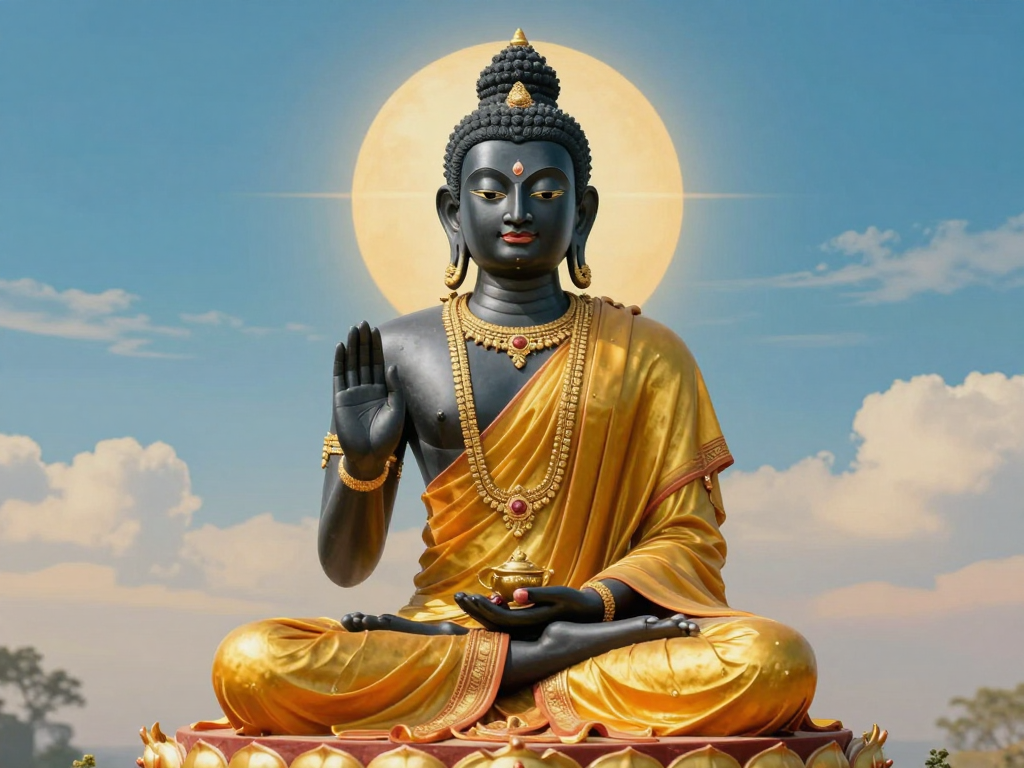
In the same century that gave the world the Buddha, Confucius, and the great Hebrew prophets, a Kshatriya prince in the Gangetic plain of ancient India renounced his throne, stripped away every possession including his clothing, and embarked on twelve years of the most austere spiritual practice the world has ever documented. What Vardhamana Mahavira achieved at the end of that journey — Kevala Jnana, complete and omniscient knowledge — and what he taught from it, produced one of humanity's oldest continuously practised religions, and gave the world its most thorough and philosophically rigorous defence of non-violence.
Jainism
Mahavira
South Asia · c. 599 – 527 BCE
Key Dates at a Glance
- 599 BCEBorn Vardhamana in Vaishali (modern Bihar) to King Siddhartha and Queen Trishala of the Licchavi clan
- 569 BCEThe Great Renunciation at age 30 — pulls out his own hair by the roots, discards all clothing, and enters twelve years of intense ascetic practice
- 557 BCEAttains Kevala Jnana (omniscience) under a Sal tree near the Rijupalika River; begins thirty years of teaching
- 557–527 BCETravels throughout the Ganges plain; establishes the fourfold Jain community of monks, nuns, laymen, and laywomen
- 527 BCEAttains Moksha (final liberation) at Pavapuri, Bihar; the Jain calendar begins — Mahavir Nirvan Samvat
Historical & cultural background
The Axial Age and the Crisis of the Vedic Order
Mahavira was born in 599 BCE — or 540 BCE according to some scholarly reconstructions — into the extraordinary intellectual ferment of the Axial Age. The Gangetic plain of the sixth century BCE was undergoing a social and religious upheaval comparable to the one that was simultaneously producing Confucius in China, the pre-Socratics in Greece, and the Hebrew prophets in Judea. New kingdoms were displacing older tribal structures; trade was generating urban wealth and new merchant classes; and the ancient Brahmanical order — with its emphasis on elaborate Vedic sacrifice, priestly authority, and caste hierarchy — was being questioned with gathering intensity.
Into this world came the great Shramana (renunciant) movements — of which Jainism and Buddhism are the two that survived to the present day. Where the Brahmanical tradition located spiritual authority in the Vedas, in hereditary priestly lineages, and in the correct performance of ritual sacrifice, the Shramana movements rejected all three. They held that liberation came not from the intervention of gods or priests, but from the individual's own sustained effort — through renunciation, meditation, ethical discipline, and the direct investigation of reality. Mahavira and the Buddha were near-contemporaries and moved in overlapping geographical and social circles; the early texts of both traditions record awareness of each other's existence, though their diagnoses of the human condition and prescriptions for liberation differed profoundly.
Mahavira was not, in the Jain understanding, the founder of a new religion. He was the twenty-fourth and last Tirthankara (ford-maker, or one who makes a crossing) of the current cosmic cycle — the latest in an eternal succession of enlightened teachers who periodically re-establish the path of liberation when it has been lost. The twenty-third Tirthankara, Parshvanatha, is considered by many scholars to be a genuine historical figure who lived approximately 250 years before Mahavira, and whose community Mahavira joined and reformed. The tradition Mahavira inherited was thus already ancient; what he gave it was its definitive philosophical and ethical architecture.
The Great Hero Who Conquered Himself
Vardhamana — his birth name, meaning "one who grows" or "the increasing one" — was born into the Licchavi clan of Vaishali, a prosperous republic in what is now the state of Bihar. His father Siddhartha was a chieftain; his mother Trishala was a member of the Vajjian confederacy's ruling family. He thus grew up in the warrior aristocracy (Kshatriya) class — the same social stratum as the Buddha — surrounded by political power, wealth, and the full entitlements of noble birth. According to Jain tradition, even before his birth Trishala had fourteen auspicious dreams foretelling the arrival of a great soul, and the family's fortunes increased markedly during her pregnancy — giving him the name Vardhamana.
He married Yashoda and had a daughter, Priyadarshana. But at thirty — after the death of his parents, and with the permission of his older brother — he undertook the Great Renunciation (Diksha). In the most dramatic of the Jain accounts, he stood beneath an Ashoka tree while gods strewed flowers around him, pulled out his own hair by the roots in five handfuls (the practice of loch that initiated Jain monks still observe today rather than shaving), stripped away his clothing, and walked naked into the forest. He owned nothing. He harmed nothing. He spoke to no one for the first thirteen months of his wandering.
The twelve years of ascetic practice that followed were, by any measure, among the most severe in the history of recorded religion. Mahavira walked barefoot across the subcontinent, eating only what was freely given, fasting for extended periods, enduring heat and cold, insults and violence, with absolute equanimity. He practised Kayotsarga — the abandonment of bodily comfort — standing motionless in meditation for hours, days, even weeks at a time. He was attacked by villagers, bitten by animals, mocked by Brahmin priests. Through all of it he maintained the Samabhava — total equanimity, the absence of any reactive emotion. In the thirteenth year of his practice, meditating under a Sal tree on the banks of the Rijupalika River, he attained Kevala Jnana: complete, infinite, omniscient knowledge of all things in all times. He was now a Jina — a conqueror — and the epithet that would define his tradition: Mahavira, the Great Hero.
The Philosophy of the Conqueror
Mahavira's philosophy rests on two interlocking foundations: a precise metaphysics of the soul and karma, and an ethical system built with absolute logical consistency upon those metaphysical foundations. Together they constitute one of the most internally coherent and uncompromising philosophical systems ever devised.
In Jain metaphysics, every living being — from the mightiest god to the smallest bacterium, from the human being to the earth, water, fire, and air themselves — possesses an eternal, conscious soul (jiva). These souls are intrinsically pure, omniscient, and blissful; but they have become encrusted with karma — understood in Jainism not as a moral accounting system but as an actual subtle material substance that adheres to the soul through action, passion, and the influx of mental states. The goal of the Jain path is the complete cessation of new karmic influx (samvara) and the shedding of existing karma (nirjara) until the soul stands fully liberated — Siddha — rising to the apex of the universe in a state of infinite knowledge, infinite perception, infinite bliss, and infinite energy.
The ethical consequence of this metaphysics is Ahimsa — non-violence — as an absolute, unconditional moral principle. If every living being has a soul, then to harm any living being is to harm a soul as valuable as one's own. Mahavira extended this principle further than any thinker before or since: not only animals but plants, insects, and even single-sensed organisms (beings with only the sense of touch, including earth bodies, water bodies, fire bodies, and air bodies) have souls and deserve protection. This is why Jain monks sweep the ground before them as they walk, strain their drinking water, cover their mouths with cloth to avoid inhaling insects, and eat only before sundown (to avoid accidentally consuming organisms that emerge after dark). It is not ritual fastidiousness; it is the most thorough application of a single moral principle ever attempted in human history.
Equally distinctive is Mahavira's epistemology: the doctrine of Anekantavada — the many-sidedness of truth. Reality, he taught, is infinitely complex; no single perspective can capture the whole. Every statement about reality is true from a particular standpoint (naya) but not from all standpoints simultaneously. This generated the logical doctrine of Syadvada — "perhaps-ism" or conditional predication — which holds that every assertion must be qualified: "from this perspective, it is so; from another perspective, it may not be so; from yet another, it is inexpressible." This is not relativism — Mahavira was clear that the Jina's omniscient knowledge encompasses all standpoints simultaneously. But for non-omniscient beings, intellectual humility is not merely a virtue; it is an epistemological necessity. And from intellectual humility flows, naturally, tolerance.
A Small Community with an Outsized Conscience
Jainism has never been a mass religion in the sense that Buddhism, Christianity, or Islam are mass religions. Today it numbers approximately four to six million adherents — almost entirely in India, with diaspora communities in the United Kingdom, East Africa, and North America. Yet its cultural and philosophical influence is spectacularly disproportionate to its demographic size, and its most important export — the principle of Ahimsa — has shaped world history in ways that dwarf the tradition's modest numbers.
Within India, the Jain community has for centuries punched far above its weight in commerce, scholarship, and philanthropy. Jain merchants, forbidden by their ethics from professions involving violence against living beings (farming disturbs soil organisms; most manufacturing involves harm), gravitated historically toward trade, banking, and the learned professions. As a result, by the medieval period Jain merchants and bankers had become enormously wealthy and politically influential, funding extraordinary monuments: the temple complexes at Dilwara (Mount Abu, Rajasthan), whose marble carvings are among the finest in the world; the pilgrimage site at Palitana (Gujarat), with its 900 temples on a single hilltop; and the colossal monolithic statue of Gommateshvara at Shravanabelagola (Karnataka), carved in 983 CE from a single granite outcrop and standing 58 feet tall, one of the largest free-standing sculptures in the world.
Jain manuscript culture was among the most prolific and carefully preserved in South Asia. Jain monks and laypersons copied and maintained enormous collections of manuscripts — not only Jain texts but works of Sanskrit grammar, mathematics, astronomy, and literature — in bhandars (manuscript libraries) attached to temples. Much of what we know of classical Indian thought has survived because a Jain librarian thought it worth preserving. The mathematician Brahmagupta's works, key texts of Sanskrit poetry and drama, and numerous philosophical treatises exist today because of Jain manuscript culture.
The Most Radical Ethics in the World
The most dramatic demonstration of Mahavira's global significance came through a man who never claimed to be Jain but absorbed Jainism's deepest impulse from childhood. Mohandas Karamchand Gandhi was born in Gujarat — India's most thoroughly Jain-influenced region — and grew up surrounded by Jain merchants, monks, and laypeople for whom Ahimsa was not a spiritual ideal but a daily practice. His mother Putlibai was deeply influenced by Jain thought. The Jain monk Shrimad Rajchandra was among the most important spiritual influences of Gandhi's young adulthood. When Gandhi developed the philosophy and practice of Satyagraha — non-violent resistance — he drew explicitly on the Jain concepts of Ahimsa and Anekantavada. The principle that even one's adversary may possess truth that one cannot see, and that violence against any living being is violence against the soul — these are Mahavira's gifts to the twentieth century's most consequential political philosophy.
In the twenty-first century, Jain ethics have acquired a new and urgent relevance in the context of the global ecological crisis and the animal rights movement. Jainism's insistence on the moral status of all living beings — its recognition, two and a half millennia before modern ecology, that the earth, water, fire, and air are themselves inhabited by living souls deserving protection — positions it as perhaps the world's oldest and most coherent environmental philosophy. The Jain concept of Paryushana — the annual festival of forgiveness in which Jains ask pardon of every being they may have harmed, intentionally or otherwise — embodies a moral seriousness about the interconnection of all life that modern environmentalism is only beginning to approach.
The doctrine of Anekantavada — the many-sidedness of truth, the insistence that reality exceeds any single perspective — has attracted growing philosophical attention as a resource for thinking about pluralism, interfaith dialogue, and the epistemics of disagreement in a polarised world. In an age of absolutisms and culture wars, the logic of "perhaps it is so; perhaps it is not; perhaps it is both; perhaps it is inexpressible" has a quiet, stubborn freshness. Mahavira, who conquered himself rather than others, and who taught that the greatest victory is over one's own anger, greed, and pride, remains one of humanity's most demanding — and most necessary — teachers.
Core teachings
- 1.Do no harm to any living being, even in thought.
- 2.Tell the truth gently and carefully.
- 3.Loosen the grip of possessions on the heart.
Suggested further reading
- Paul Dundas, The Jains
These summaries are educational and simplified — they cannot capture the depth of any tradition.