
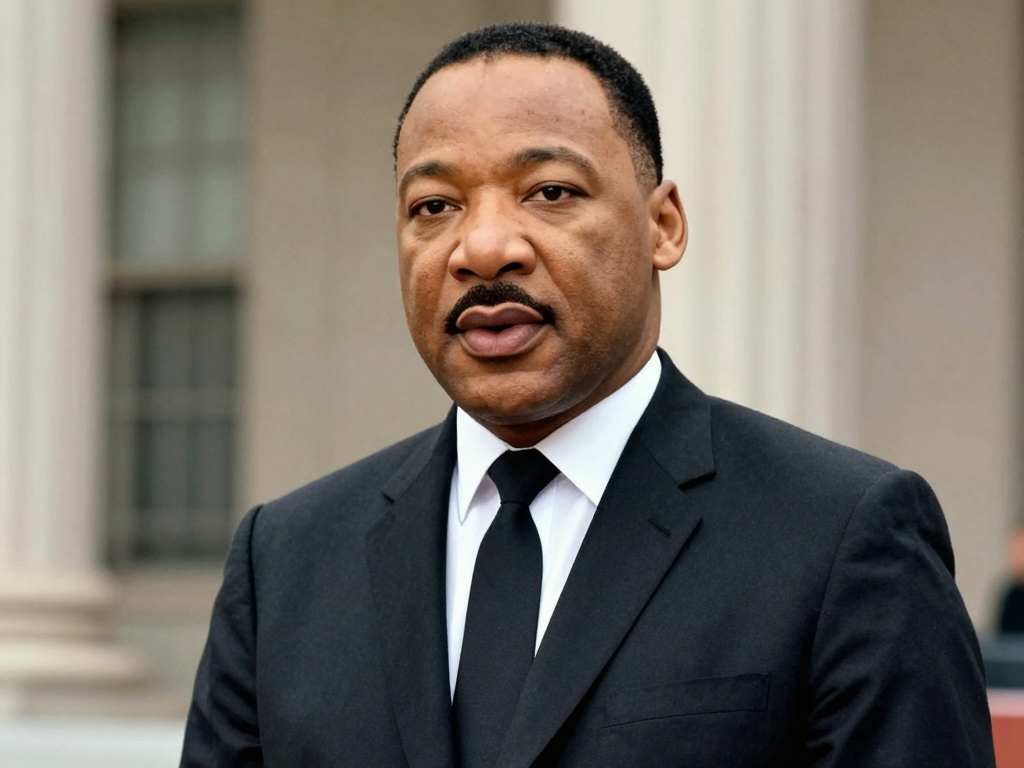
In the thirteen years between the Montgomery Bus Boycott and his assassination on a Memphis motel balcony, Martin Luther King Jr. compressed a lifetime of moral achievement that would have justified any one of the claims history makes on his name. He was a Baptist preacher who read Thoreau, Gandhi, and Hegel; a theologian of Agape who organised bus boycotts; a Nobel laureate who went to jail twenty-nine times. He did not merely change American law — he changed what Americans believed themselves capable of demanding, and what they believed they deserved.
Christianity / civil rights
Martin Luther King Jr.
Americas · 1929 – 1968 CE
Key Dates at a Glance
- 1929Born Michael King Jr. in Atlanta, Georgia; father later changes both their names to Martin Luther after the German reformer
- 1955–56Leads the Montgomery Bus Boycott — 381 days of collective action that desegregates Montgomery's buses and launches the Civil Rights Movement
- 1963"Letter from Birmingham Jail"; the Birmingham Campaign; the March on Washington and the "I Have a Dream" speech before 250,000 people
- 1964–65Nobel Peace Prize; the Selma to Montgomery marches; the Voting Rights Act — the legislative summit of the movement
- 1967–68Opposes the Vietnam War; launches the Poor People's Campaign; assassinated April 4, 1968 at the Lorraine Motel, Memphis
Historical & cultural background
Jim Crow America and the Long Shadow of Slavery
Martin Luther King Jr. was born in Atlanta, Georgia, on January 15, 1929 — sixty-four years after the Thirteenth Amendment had formally abolished slavery, and sixty-one years after the Fourteenth Amendment had guaranteed equal protection under the law. None of these constitutional guarantees had been meaningfully applied to Black Americans in the South. The system of Jim Crow — the elaborate architecture of legal racial segregation that governed every dimension of life in the former Confederate states — was at the height of its entrenchment. Black Americans in the South could not vote, could not attend the same schools or sit at the same lunch counters as white Americans, could not testify against white defendants in court, and lived under the constant threat of racial violence enforced by law enforcement and extrajudicial terror in near-equal measure. Between 1877 and 1950, over 4,000 racial terror lynchings were documented in the American South.
The world into which King was born was also, paradoxically, one of extraordinary Black cultural and intellectual vitality. Atlanta's Auburn Avenue — where King grew up in his grandfather's and then his father's church — was known as "Sweet Auburn," one of the most prosperous Black business districts in America. The Harlem Renaissance had produced a flowering of African American literature, art, and music through the 1920s. The NAACP (founded 1909) had been waging legal battles against segregation for two decades. W.E.B. Du Bois, whose concept of "double consciousness" — living simultaneously as Black and American in a society that treated these as incompatible — would profoundly shape King's own self-understanding, was at the height of his influence. The intellectual tradition King inherited was rich, embattled, and urgently alive.
The specific historical moment that made the Civil Rights Movement possible was shaped by World War II and its aftermath. Black veterans who had fought for democracy abroad returned home to find democracy denied at home — and with less willingness to accept it. The Cold War gave the American government a powerful international incentive to address domestic racism: the Soviet Union routinely cited American segregation in its propaganda, and newly independent African and Asian nations were watching how the United States treated its Black citizens. When King and his movement made their demands, they did so in a context where American global credibility had become a genuine argument for justice — and they knew it, and used it.
The Preacher Who Became a Prophet
Michael King Jr. — he would not receive the name Martin Luther until his father changed both their names after a 1934 trip to Germany — grew up in the most deeply churched environment imaginable. His grandfather, the Reverend A.D. Williams, had built Ebenezer Baptist Church in Atlanta into a major community institution; his father, "Daddy King," had succeeded him and was one of the most influential Black clergymen in Georgia. King thus grew up not merely as a Christian but as a son of the Black Baptist church in all its specific social and political dimensions — a tradition in which the sermon was the primary art form, the congregation was the primary civic institution, and the preacher was expected to speak not only to souls but to conditions.
He was intellectually precocious — entering Morehouse College at fifteen, earning his divinity degree from Crozer Theological Seminary in Pennsylvania (where he discovered Gandhi's philosophy of nonviolent resistance), and his PhD in systematic theology from Boston University in 1955. He was twenty-six years old, freshly installed as pastor of Dexter Avenue Baptist Church in Montgomery, Alabama, when Rosa Parks was arrested for refusing to give up her bus seat on December 1, 1955. The Black community of Montgomery, already organised and already planning action, chose King to lead their boycott of the city's bus system. He was young, gifted, and — crucially — new enough to Montgomery that he had not yet accumulated enemies within the community.
The 381-day Montgomery Bus Boycott transformed him from a promising young pastor into a national figure and launched the Southern Christian Leadership Conference (SCLC), the organisation that would coordinate the Civil Rights Movement's campaigns over the following decade. What followed was a life of extraordinary moral courage and extraordinary physical danger: his home was bombed; he was stabbed in the chest by a deranged woman at a book signing in 1958 (the blade resting millimetres from his aorta); he was arrested twenty-nine times; he was surveilled by the FBI under J. Edgar Hoover, who considered him the most dangerous man in America and attempted to blackmail him into suicide. Through all of it he maintained the discipline of nonviolence — not merely as a tactic but as a theology.
The Theology of Nonviolent Resistance
King was not merely a civil rights organiser who happened to be a minister; he was a theologian whose political strategy was inseparable from his theology. The philosophy of nonviolent direct action that drove the Civil Rights Movement was built on a specific intellectual architecture, and King was both its synthesiser and its most eloquent explainer.
The foundation was his concept of Agape — the Greek New Testament word for unconditional, self-giving love that does not depend on the worthiness of its object. Agape, for King, was not sentiment but a disciplined choice: the decision to see the humanity in one's oppressor, to refuse to dehumanise in return for being dehumanised. This was the theological core of nonviolence: violence reduces the oppressor to their worst act; nonviolence insists on their full humanity and summons them toward it. It was also, he argued, the only form of resistance that could win — because it sought not the defeat of the opponent but their conversion, creating what he called the Beloved Community: a society of mutual recognition and shared humanity that had never yet existed but was always possible.
From Gandhi he drew the specific mechanics of nonviolent direct action — the boycott, the march, the sit-in, the deliberate acceptance of suffering — and the strategic insight that suffering accepted openly in the presence of an unjust opponent reveals the injustice to the world. From Thoreau he drew the concept of civil disobedience: the moral obligation to disobey unjust laws, accepting the legal consequences openly as a testimony to the higher law being violated. From Paul Tillich and Reinhold Niebuhr he drew a sophisticated understanding of sin as structural as well as personal — the "system of evil" that required collective dismantling, not merely individual moral reformation.
What distinguished King from almost every predecessor was his insistence that nonviolence was not the tool of the weak but of the supremely disciplined — and that the oppressed community's willingness to absorb violence without retaliation was a form of power, not of submission. "We will match your capacity to inflict suffering with our capacity to endure suffering," he told his opponents. "We will not hate you, but we cannot in all good conscience obey your unjust laws. Do to us what you will. And we will still love you." This was not passivity. It was moral judo of extraordinary force.
The Movement That Remade America
The legislative achievements of the Civil Rights Movement under King's leadership were concrete and transformative. The Civil Rights Act of 1964 — signed into law by President Lyndon Johnson partly on the moral momentum created by the Birmingham Campaign and the March on Washington — outlawed discrimination based on race, colour, religion, sex, or national origin in employment and public accommodations. The Voting Rights Act of 1965, passed in the direct aftermath of the Selma marches and "Bloody Sunday," prohibited racially discriminatory voting practices and transformed the political landscape of the South. Between 1965 and 1970, Black voter registration in Mississippi rose from 6.7% to 59.8%. These were not symbolic gestures; they were the remaking of American democracy.
King's cultural impact extended far beyond legislation. The "I Have a Dream" speech delivered on August 28, 1963 at the Lincoln Memorial is the most anthologised, most studied, and most quoted piece of American oratory since the Gettysburg Address — a work that drew simultaneously on the Baptist sermon tradition, the cadences of the King James Bible, the Declaration of Independence, and the full resources of the African American musical and rhetorical inheritance. Its final movement — the repeated "I have a dream" and "let freedom ring" passages — operates as music as much as argument, building to an emotional and moral crescendo that has never been surpassed in American public speech.
The Letter from Birmingham Jail — written in the margins of newspapers and on scraps of paper while King sat in solitary confinement in April 1963, responding to eight white clergymen who had called his direct action campaigns "unwise and untimely" — is widely taught as one of the greatest pieces of American prose, standing in the tradition of Jefferson's Declaration, Thoreau's "Civil Disobedience," and Lincoln's Second Inaugural as a foundational document of American moral thought. It was also, in practical terms, one of the most effective pieces of political persuasion produced in the twentieth century.
The Unfinished Work — and the Full King
One of the most important and least comfortable facts about Martin Luther King Jr.'s legacy is how selectively it has been remembered. The King most widely commemorated — on the federal holiday that bears his name, on the National Mall memorial unveiled in 2011, in the speeches of politicians across the spectrum — is primarily the King of the 1963 "Dream" speech: the prophet of racial harmony, the dreamer of an America where people are judged not by the colour of their skin but by the content of their character. This King is universally beloved and entirely safe.
The full King is considerably more demanding. In the last three years of his life, King turned his attention to the structural causes of poverty, arguing that the Civil Rights Acts were necessary but insufficient without economic transformation. His Poor People's Campaign (1967–68) called for a guaranteed annual income, full employment, and massive federal investment in housing and education — positions that placed him firmly outside the mainstream of either political party. His 1967 speech "Beyond Vietnam: A Time to Break Silence" denounced the Vietnam War as a moral catastrophe and drew bitter condemnation from former allies, including President Johnson, as well as the editorial boards of both the New York Times and the Washington Post. A Gallup poll in the months before his assassination found his approval rating at 32% — lower than at any point since his rise to prominence.
He was assassinated on April 4, 1968, in Memphis, Tennessee, where he had gone to support a strike by the city's sanitation workers — majority Black men who marched carrying signs reading "I Am a Man." He was thirty-nine years old. The federal holiday in his honour was signed into law in 1983, fifteen years after his death — over opposition that included then-Senator Jesse Helms. His FBI file, which documented years of illegal surveillance and active attempts to destroy him, was partially declassified beginning in the 1970s; court-ordered seals on the most sensitive materials are scheduled to expire in 2027. The full account of what was done to him — and by whom — is still not entirely public.
Core teachings
- 1.Injustice anywhere is a threat to justice everywhere.
- 2.Hate cannot drive out hate; only love can do that.
- 3.The arc of the moral universe is long, but it bends toward justice.
Suggested further reading
- Letter from Birmingham Jail
- Strength to Love
These summaries are educational and simplified — they cannot capture the depth of any tradition.