
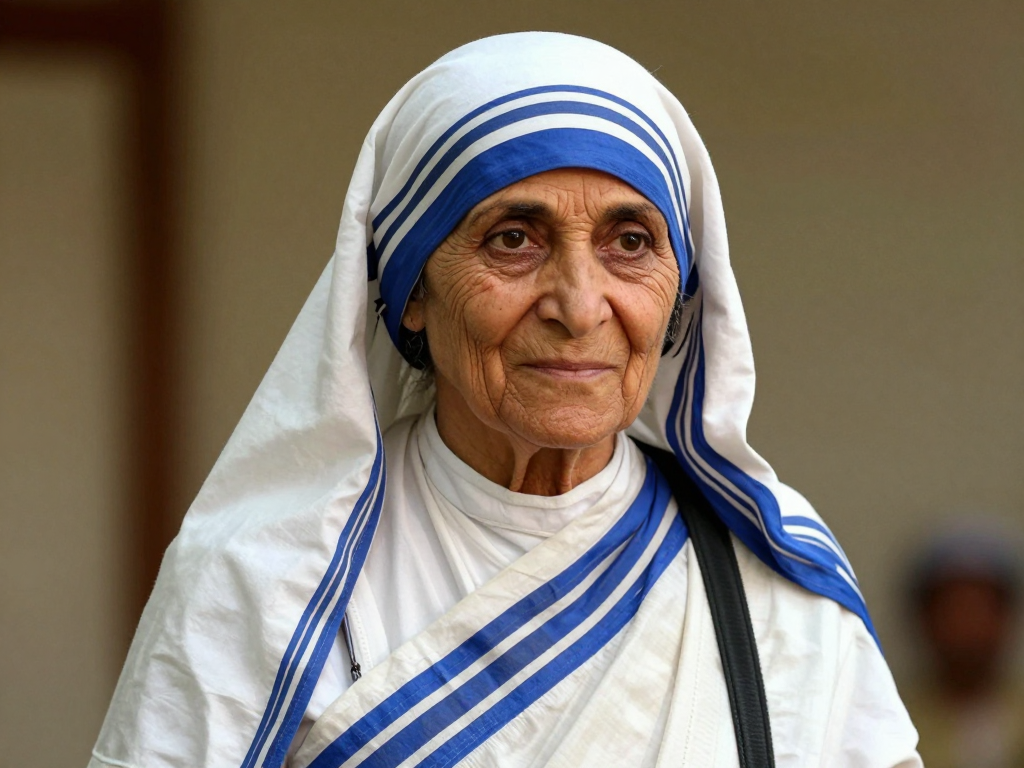
Born Anjezë Gonxhe Bojaxhiu in Skopje in 1910, she left home at eighteen and never returned. She became Irish, then Indian, then — in a sense that transcended nationality — simply the woman in the white-and-blue sari kneeling in the streets of Calcutta beside someone no one else would touch. For nearly half a century she built, with extraordinary practicality and even more extraordinary faith, an institution that now operates in 139 countries. In 2016 she was declared a saint. The questions her life raises — about poverty, dignity, suffering, and the nature of compassion itself — have never been more urgent.
Christianity
Mother Teresa
Europe · 1910 – 1997 CE
Key Dates at a Glance
- 1910Born Anjezë Gonxhe Bojaxhiu in Skopje, Ottoman Macedonia (now North Macedonia), to an Albanian Catholic family
- 1928–48Joins the Sisters of Loreto in Dublin; travels to India; teaches at St. Mary's School, Calcutta for seventeen years
- 1946"The Call within the Call" — on a train to Darjeeling she hears Christ instruct her to leave the convent and serve the poorest of the poor
- 1950–52Founds the Missionaries of Charity; opens Nirmal Hriday (Pure Heart) — the Home for the Dying — in a former temple to Kali in Kalighat
- 1979–97Receives the Nobel Peace Prize; continues global expansion of her order; dies September 5, 1997; canonised September 4, 2016
Historical & cultural background
From the Balkans to the Streets of Calcutta
Anjezë Bojaxhiu was born on August 26, 1910, in Skopje — then part of the Ottoman Empire, now the capital of North Macedonia — into a prosperous Albanian Catholic family. Her father Nikollë was a successful merchant and local political figure who died suddenly when Anjezë was eight, a loss that shattered the family's finances and left a permanent mark on the girl who would spend her life with the destitute. Her mother Dranafile raised three children in devoted Catholic faith, regularly bringing the poor into their home for meals — the first model Teresa ever had of practical charity.
She was drawn to the missionary life from childhood, inspired by letters from Jesuit missionaries in Bengal. At eighteen, she left Skopje for Dublin to join the Sisters of Loreto — an Irish congregation running schools across India — and within six weeks was on a ship to Calcutta. She would never see her mother or sister again. Calcutta in 1929 was one of the most densely populated and socially stratified cities on earth: the capital of British India until 1911, still a major commercial hub, and a city of extreme contrasts between the colonial grandeur of its European quarters and the desperate poverty of its bustees (slums). Teresa taught geography at St. Mary's, an elite school for girls of the upper and middle classes, from behind convent walls — physically proximate to the streets of Calcutta but entirely separated from them.
The event that changed everything came on September 10, 1946 — a date the Missionaries of Charity observe annually as Inspiration Day. On a train to Darjeeling for her annual retreat, Teresa experienced what she later described as "the call within the call": a direct communication from Christ instructing her to leave the convent and serve the poorest of the poor, living among them. It took two years of careful negotiation with Church authorities — an often overlooked dimension of her story — to obtain permission to leave the Loreto order while remaining a nun. She was thirty-eight years old when she stepped out of the convent in 1948, exchanged her Loreto habit for a white cotton sari with three blue stripes, and walked into the slums with no money, no institution, and no plan beyond the instruction she had received.
The Woman Who Touched the Untouchable
The early years of Teresa's work in Calcutta were ones of almost unimaginable difficulty. She had no funds, no institutional backing, and no staff — only the conviction of her call and a willingness to begin where others would not look. She opened a school for children in the Motijhil slum, drawing letters in the mud with a stick. She went to hospitals and found patients turned away to die in the streets because they could not pay. She picked up a woman being eaten by rats and ants from a Calcutta pavement and refused to leave until she was admitted to hospital — and when hospitals continued to turn away the destitute dying, she founded her own.
In 1952, the city of Calcutta gave her the use of a building adjacent to the Kalighat temple — a dharamshala (pilgrims' rest house) that had fallen into disuse. She transformed it into Nirmal Hriday ("Pure Heart" or "Place of the Immaculate Heart"), a home for the dying. Its purpose was simple and radical: to give people who had lived like animals the dignity of dying like human beings — cleaned, fed, held, and accompanied. No medical heroics; no attempt to prolong life at all costs. Simply the presence of another person who had chosen to be there. In its first years it was deeply controversial — Hindu nationalists objected to a Christian nun operating in a building associated with the goddess Kali — until the day Teresa was found nursing a Hindu priest who was dying of cholera. After that, the protests largely stopped.
The organisation she built from nothing — the Missionaries of Charity, canonically established on October 7, 1950 — grew with a speed that repeatedly surprised even Teresa. By the time of her death in 1997 it operated 610 missions in 123 countries, running homes for the dying, orphanages, leprosy clinics, mobile medical units, soup kitchens, and schools. She had become, in the last two decades of her life, one of the most recognisable human beings on earth — an involuntary celebrity who used her extraordinary global visibility with disciplined single-mindedness to advocate for the poor and against abortion, speaking with equal directness to world leaders and to the woman dying on the pavement.
The Theology of the Poorest of the Poor
Teresa's theology was not academic — she read no systematic theology, wrote no treatises, and was suspicious of intellectual complexity that did not lead to action. But it was, in its own way, as precise and as demanding as any medieval schoolman's. At its centre was a single, radical proposition: that the poor person is Christ. Not like Christ, not representative of Christ, not deserving of charity because Christ commands it — but literally, sacramentally, actually Christ, present in the most distressing disguise of human misery.
This was the conviction that drove her to pick up the dying from Calcutta's pavements, to bathe lepers, to hold the hands of people whom the rest of society had decided were not worth the trouble. "Each one of them is Jesus in disguise," she said with a simplicity that concealed its theological depth. It was a direct application of the twenty-fifth chapter of Matthew's Gospel — "Whatever you did for the least of these brothers and sisters of mine, you did for me" — taken with a literalness that most Christians find inspiring to admire and nearly impossible to practise. Teresa simply practised it.
Her spirituality was deeply rooted in the "little way" of Thérèse of Lisieux — the nineteenth-century French Carmelite whose insight was that holiness does not require great deeds but the faithful doing of small things with great love. Teresa took this principle and applied it at industrial scale, insisting that her work was not social work at all but an act of love performed one person at a time. "We can do no great things, only small things with great love," she said — a sentence that has been reproduced so often it has been nearly drained of the radicalism it contains. It was, in practice, a refusal to think in the categories of policy, programme, or systemic change. Each dying person was not a statistic in a humanitarian crisis; each was a unique human being in whom Christ was present, deserving of full attention, full presence, and full love.
A Conscience in a White Sari
The cultural impact of Mother Teresa is inseparable from the phenomenon of her global visibility — a visibility she did not seek and consistently found burdensome, but which she wielded with considerable strategic intelligence in the service of her mission. The pivotal moment in her transformation from local Calcutta nun to global icon was Malcolm Muggeridge's 1969 BBC documentary Something Beautiful for God — a film whose production was itself attended by what Muggeridge believed was a miraculous quality of light inside Nirmal Hriday. Whatever the explanation for the light, the film reached millions of viewers across Britain and the English-speaking world and introduced Teresa to an international audience.
The Nobel Peace Prize of 1979 completed her transformation into a global symbol. Her acceptance speech — in which she declined the traditional Nobel banquet, asking that the funds be redirected to the poor, and used the occasion to speak without diplomatic evasion about poverty, abortion, and the "greatest destroyer of peace" being unwanted children — was received as one of the most extraordinary Nobel addresses ever delivered. Over the following two decades she met with virtually every head of state and major religious leader of the era, including multiple popes, US presidents, Mikhail Gorbachev, Fidel Castro, and Princess Diana. She used every encounter for the same purpose: to advocate for the destitute.
The Missionaries of Charity she founded now constitute one of the most geographically extensive humanitarian organisations in the world. They operate across distinctions of politics, religion, and conflict zone that defeat most NGOs — running programmes in Communist Cuba, in Taliban-era Afghanistan, in war zones in Sudan and Syria — precisely because they make no political demands, take no governmental funds (by policy), and ask only to be permitted to serve the poorest. The blue-and-white sari is, in this sense, a form of passport.
The Saint in the Shadow of Controversy
Mother Teresa is, in one sense, the most unambiguously admired religious figure of the twentieth century — and in another, one of the most contested. The admiration is easy to understand: a woman who gave everything, literally everything, to serve the most abject of the poor for fifty years, who accepted no personal wealth or comfort, and who did it not from ideology or programme but from a love she experienced as directly commanded. The contestation is worth taking seriously rather than dismissing.
Critics — most prominently the late Christopher Hitchens in his polemic The Missionary Position (1995) — raised serious questions about the quality of medical care in her homes (where pain relief was often inadequate and the theological meaning of suffering was emphasised in ways that critics argued prolonged rather than eased it); the opacity of the Missionaries of Charity's finances (hundreds of millions of dollars donated globally, with limited public accounting); and the political associations of some of her later years, including friendships with figures like the Duvaliers of Haiti. These are not frivolous criticisms. They invite a serious examination of the difference between sanctity and effectiveness, between witnessing to love and providing optimal healthcare, between a religious charism and a humanitarian programme.
The revelation in Come Be My Light (2007) — the publication of Teresa's private letters showing that she experienced nearly fifty years of interior spiritual darkness, feeling no consolation, no sense of God's presence, no warmth in prayer — added an entirely new dimension to her story. For some commentators it undermined her faith; for theologians of spirituality it placed her in the ancient tradition of the dark night of the soul described by John of the Cross, and made her witness arguably more rather than less remarkable: she served the dying and the destitute for half a century not on the fuel of spiritual consolation but in its near-total absence, sustained by will, discipline, and the community she had built. That, many argue, is not the story of a saint diminished — it is the story of a saint's full stature finally visible.
Core teachings
- 1.Do small things with great love.
- 2.The dignity of the dying matters as much as the dignity of the living.
- 3.See the face of the divine in the person in front of you.
Suggested further reading
- Mother Teresa, Come Be My Light
These summaries are educational and simplified — they cannot capture the depth of any tradition.