
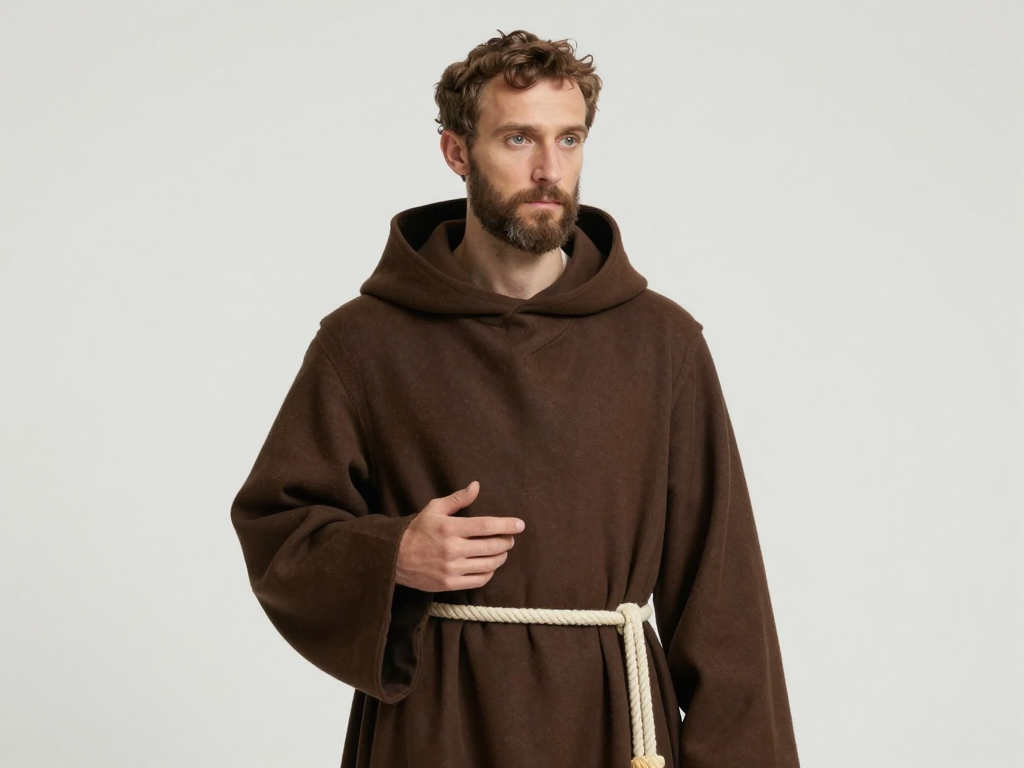
Born to a prosperous cloth merchant in the hill town of Assisi in 1181 or 1182, Giovanni Bernardone spent his youth as a carefree troubadour and aspiring knight before a series of visions turned him toward the most radical poverty the medieval Church had seen. The movement he founded — the Friars Minor, the Little Brothers — became one of the largest religious orders in Christian history, and the man himself became, within two years of his death, the most rapidly canonised saint in papal history: a figure whose embrace of poverty, love of creation, and joyful simplicity has never ceased to astonish, challenge, and inspire.
Christianity
St. Francis of Assisi
Europe · c. 1181 – 1226 CE
Key Dates at a Glance
- 1181/82Born Giovanni di Pietro di Bernardone in Assisi, Umbria; father Pietro is a wealthy cloth merchant
- 1205–06Series of visions, including Christ speaking from the crucifix at San Damiano: "Francis, go and repair my Church"
- 1209Pope Innocent III verbally approves the first Rule of the Friars Minor; Francis and eleven companions begin their itinerant preaching
- 1219Crosses enemy lines during the Fifth Crusade to meet Sultan al-Kamil of Egypt in Damietta — one of history's most remarkable interfaith encounters
- 1224–26Receives the stigmata on La Verna; composes the Canticle of the Creatures; dies at the Portiuncula chapel, Assisi, October 3, 1226
Historical & cultural background
Medieval Christendom on the Brink of Crisis
Francis was born into one of the most turbulent and creative centuries of medieval European history. The twelfth and thirteenth centuries saw the height of papal power under Innocent III, the launch of multiple Crusades to the Holy Land, the Albigensian Crusade against the Cathar heresy in southern France, the founding of the great Gothic cathedrals, the rise of the first European universities, and the emergence of a prosperous merchant class that was quietly dissolving the feudal order from within.
The Church that Francis grew up in was, in many respects, a church of extraordinary worldly power and wealth. Bishops governed territories; abbots commanded the labour of thousands; the Pope commanded kings. The physical magnificence of ecclesiastical architecture — Chartres was under construction during Francis's lifetime, the great Romanesque monasteries of Burgundy and Lombardy were in their prime — expressed a theology in which the beauty of God was rendered in stone and gold. Yet this very wealth had become, for many Christians, a source of spiritual scandal. Reform movements proliferated: the Waldensians in Lyons, the Humiliati in Lombardy, the Cathars in Provence, all challenged clerical wealth and called for a return to apostolic poverty. Most were condemned as heretics.
The social world of Assisi itself was a microcosm of wider tensions. The commune was locked in bitter conflict between the minores — the lesser people, artisans and merchants — and the maiores, the old feudal nobility. Pietro Bernardone, Francis's father, belonged to the upwardly mobile merchant class made newly wealthy by the cloth trade with France — hence the nickname "Francesco" (the Frenchman) he gave his son, born while he was away on a trading journey. Francis grew up at the intersection of old chivalric ideals and new mercantile prosperity, and his conversion can be read, in part, as a radical rejection of both.
From Troubadour to Beggar — and Back Again
The young Francis Bernardone was, by all accounts, a charming, generous, and extravagant young man — the life of every party in Assisi, a lover of the Provençal troubadour poetry that was sweeping through the Italian towns, a dreamer of chivalric glory. He was captured in a skirmish with Perugia in 1202 and spent a year as a prisoner; he fell gravely ill on his release. Both experiences cracked open something in him. He attempted to go to war again in 1205, riding south toward Apulia to join the Fourth Crusade, but turned back after a dream instructed him that he was following the wrong lord. Back in Assisi, wandering in the countryside around the ruined chapel of San Damiano, he knelt before a Byzantine crucifix and heard a voice speak from it directly: "Francis, go and repair my Church, which, as you can see, is falling into ruin."
He took the command literally at first — selling cloth from his father's warehouse to fund repairs to San Damiano. Pietro Bernardone, furious, hauled his son before the Bishop of Assisi for restitution. Francis's response became one of the most dramatic gestures in the history of Christianity: he stripped off every garment he was wearing, handed the clothes back to his father, and stood naked before the assembled crowd, declaring that henceforth he had only one Father — the one in heaven. The Bishop, moved, wrapped him in his own cloak. Francis walked out of Assisi as a beggar. He was twenty-four years old.
What followed over the next twenty years was a life of extraordinary intensity: rebuilding ruined chapels with his own hands, nursing lepers in the lazarettos outside Assisi's walls, preaching to peasants in the fields, attracting disciples of every social background until his community of Little Brothers numbered in the thousands. In 1219, during the Fifth Crusade, he crossed the battle lines at Damietta in Egypt to meet personally with Sultan al-Kamil — an encounter so improbable, so apparently mad, and so genuinely warm that it stands as one of history's most extraordinary moments of interfaith encounter. The Sultan, deeply impressed, offered him gifts and safe passage; Francis offered him friendship and the Gospel, and returned unmolested. In 1224, on the rocky summit of La Verna in Tuscany, Francis received the stigmata — the wounds of Christ's Passion appearing in his own hands, feet, and side — the first documented case in Christian history. Two years later, nearly blind, wracked with illness, he was laid on the bare earth at the Portiuncula chapel and died singing.
Poverty, Creation, and the Joy of the Lesser Way
Francis was not a systematic theologian — he was suspicious of learning that puffed up rather than humbled, and is said to have told his brothers that a great scholar who joined the order brought nothing with him, while a simple peasant brought his own body. His theology was lived rather than written, embodied rather than argued. Yet from that embodied theology several distinctive and historically revolutionary insights emerge with crystalline clarity.
The first and most defining is his understanding of poverty — not as a regrettable necessity, but as a positive spiritual condition, even a form of freedom. Francis called poverty his "Lady" — a deliberate echo of the troubadour convention of courtly love, redeployed to describe his relationship with dispossession. He insisted that his brothers own nothing, individually or collectively — not even the churches they prayed in, which they held only in use. This absolute poverty was his response to the Church's wealth and his reading of the Gospel: Jesus had said "sell all you have and give to the poor"; Francis took him literally. The Rule he wrote for his brothers — fought over, diluted, revised by Church authorities throughout his lifetime — was, in its original form, simply a chain of Gospel quotations about poverty. That was sufficient, he felt, for a complete guide to life.
The second great Franciscan insight is his theology of creation. The Canticle of the Creatures — composed near the end of his life, nearly blind, in great physical pain — is among the most beautiful poems in Italian literature and among the most theologically radical statements about the natural world in any religious tradition. It addresses the sun, the moon, the wind, water, fire, and earth as siblings — "Brother Sun," "Sister Moon," "Brother Wind," "Sister Water," "Brother Fire," "Sister Mother Earth." This is not pantheism; Francis does not worship creation as divine. But he insists that all creatures, by existing and doing what their nature directs them to do, praise God — and that the human person's relationship to the natural world is one of kinship, not dominion. Seven centuries before the environmental movement, Francis articulated an ecological spirituality of startling contemporaneity.
The Little Poor Man Who Changed Everything
The cultural consequences of Francis's life are almost impossible to overstate — and they cut across the religious and secular divide in ways that make him unique among medieval saints. Within the Church, the Franciscan order he founded became within a century one of the largest institutions in Christendom, with friaries in every major European city. Franciscan scholars — Bonaventure, Duns Scotus, Roger Bacon, William of Ockham — were among the most important philosophical and scientific minds of the thirteenth and fourteenth centuries. The Franciscan emphasis on the particularity and value of individual things (as opposed to Thomistic universals) contributed significantly to the nominalist revolution in philosophy that helped clear the ground for the Scientific Revolution.
In the arts, Francis's impact was transformative. He is credited with popularising the Christmas crèche — the living Nativity scene he staged at Greccio in 1223, which became the ancestor of every nativity scene in every church and town square in the Western world. The Franciscan commission to Giotto di Bondone to fresco the Basilica of San Francesco in Assisi produced what many art historians regard as the foundational works of Western painting — the point at which medieval iconographic flatness gave way to the naturalism and emotional expressiveness that would reach full flower in the Renaissance. Giotto's frescoes depicting the life of Francis are, in the fullest sense, the beginning of modern art.
Beyond the Church, Francis's influence on Western literature and poetry has been profound and persistent. The Canticle of the Creatures is not only the first great poem in the Italian vernacular — it is the founding document of Italian literature, predating Dante's Divine Comedy by nearly a century. The Fioretti di San Francesco (Little Flowers), the charming collection of legends about Francis and his companions compiled in the late thirteenth century, created a new literary genre — the saint's life as joyful novella — that influenced Boccaccio, Chaucer, and ultimately the entire tradition of vernacular European storytelling.
The Saint the World Cannot Stop Loving
Francis of Assisi has the remarkable distinction of being, by most surveys, the most beloved and most universally admired figure in the entire Catholic canon — beloved not only by Catholics but by Protestants, by people of other faiths, and by the non-religious. His image — the brown-robed friar with birds perched on his outstretched hands — is one of the most recognisable in the world, appearing in countless garden statues, children's books, and hospital chapels. The prayer attributed to him ("Lord, make me an instrument of your peace") has been read at funerals, civil ceremonies, and United Nations gatherings. It was read by Senator Robert Kennedy's widow Ethel at his funeral in 1968.
The election of Cardinal Jorge Mario Bergoglio as Pope in March 2013 — and his choice of the name Francis, the first pope ever to take that name — was immediately understood by the watching world as a statement of intent: a Church returning to simplicity, to the poor, to creation. His 2015 encyclical Laudato Si' — its title drawn directly from the opening words of the Canticle of the Creatures — became the most widely read papal document in modern history, translated into dozens of languages and cited in climate negotiations, ecological theology, and environmental activism worldwide. The Franciscan tradition, which had been making this argument for eight centuries, suddenly found itself speaking at the centre of the world's most urgent conversation.
There are today approximately 1.8 million Franciscans worldwide across the three orders — friars, Poor Clares, and Secular Franciscans — making the Franciscan family the largest religious order in the Catholic Church. They operate hospitals, schools, and mission stations on every inhabited continent. The town of Assisi itself — a UNESCO World Heritage Site since 2000 — receives five million pilgrims and tourists every year, drawn by the frescoes of Giotto, the Basilica of Santa Chiara, and the simple Portiuncula chapel where Francis was born as a friar and died as a saint. In a world saturated with information and accumulation, the memory of a man who owned nothing and loved everything retains an almost gravitational pull.
Core teachings
- 1.Where there is hatred, sow love; where there is injury, pardon.
- 2.Live simply so others may simply live.
- 3.Treat the earth as kin.
Suggested further reading
- The Little Flowers of St. Francis
These summaries are educational and simplified — they cannot capture the depth of any tradition.